


By: Jon Costello
I’ve expressed my interest in offshore drillers in several recent articles, including today’s macro update. These companies have made it through what was arguably their industry’s worst-ever downturn and are now poised to profit in the upcycle.
My top pick in the sector has been Valaris (VAL), but others like Noble Energy (NE) and Transocean (RIG) also deserve a look. This article discusses Transocean’s risks and upside potential.
Recent Share Price Underperformance
Transocean is one of the few global offshore drilling service contractors that has avoided bankruptcy in the offshore drilling downturn that began in 2014. Its defining characteristic vis-à-vis its peers is its high-quality assets and large contract backlog. Its negative is its heavy debt load. Its peers discharged most of their long-term debt in bankruptcy. In the process, the pre-bankruptcy equity was all but wiped out, and most debt was converted to equity. They emerged with conservative financial profiles and slimmed-down balance sheets.
Transocean’s debt load and the risk that it enters bankruptcy if the offshore drilling cycle remains depressed have caused its shares to dramatically outperform its large peers since they exited bankruptcy in the 2021-2022 timeframe.
The company’s higher risk is responsible for its underperformance in the most recent downturn for offshore drilling stocks. Whereas its peers have bounced hard over recent weeks, Transocean’s shares have lagged, as shown below.
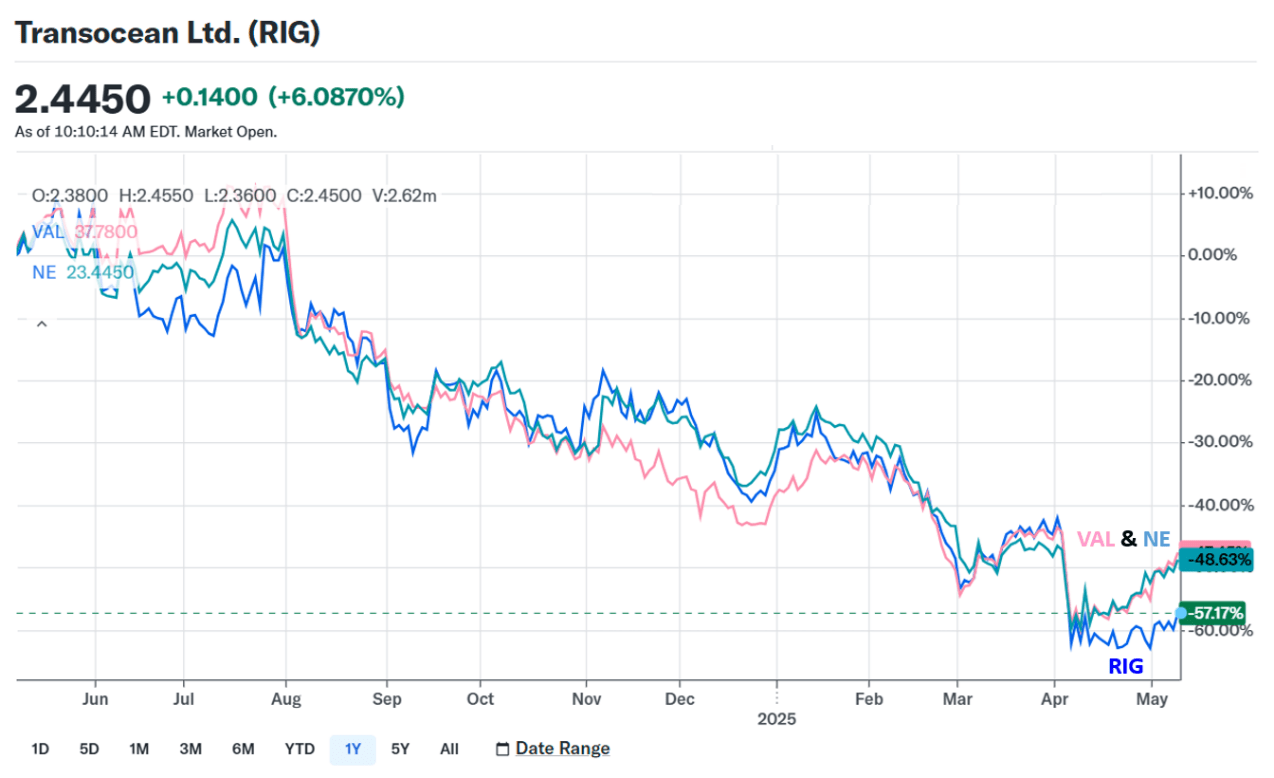
Source: Yahoo! Finance, May 8, 2025. Tickers added by author.
Risks remain for Transocean’s shareholders, which could cause its stock to continue to lag those of its peers. First and foremost among them is its large legacy debt load. Investors in Transocean’s stock must be confident that the company can meet its debt obligations and survive the current oil market downturn in a form that allows its shares to participate in the subsequent upturn.
Drillship and Semisubmersible Backdrop
The global rig fleet currently includes 109 drillships and 92 semisubmersibles, inclusive of “stacked” rigs, which are the rigs that have been temporarily idled. There are 14 drillships and 13 semisubmersibles that have been “cold stacked,” or maintained at minimal expense.
In 2023, investors began to anticipate an offshore cyclical recovery, as demand for floaters and semisubmersible rigs grew to a point at which contract rates began to increase and stacked rigs were reactivated. However, activity began to slow in late 2024 after major oil companies postponed projects.
While the upcycle has been paused since then, all signs indicate the longer-term recovery is still underway. Contract rates, which hovered in the range of $200,000 per day, increased into the high $400,000s and low $500,000s in 2024. They have since declined to the mid-to-low $400,000 range today. At the current level, the major offshore drillers are operating close to cash flow neutrality.
The next few years will likely see continued attrition of the existing floater and semisubmersible fleets, while new offshore project upstarts will add to the demand for existing offshore rigs. Amid this backdrop, the offshore drilling service companies will see their cash flow inflect higher, as rates increase and stacked rigs are reactivated.
Transocean’s Risks
The main risk for Transocean shareholders stems from the company’s heavy debt load. Large interest expenses consume a significant part of free cash flow, and debt has to be refinanced when it comes due. Shareholders also run the risk of dilution in the company’s efforts to service its debt.
If Transocean can continue to generate ample cash flow, as it has over recent years, its future long-term debt maturity schedule will not be particularly onerous. It should have little trouble rolling over debt when it comes due as long as the debt markets remain healthy.
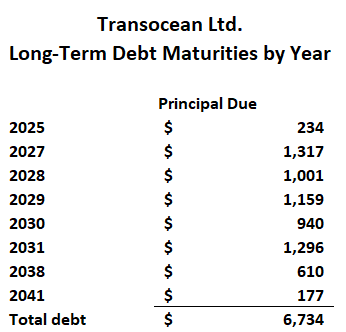
The near-term picture is not a cause for concern. Transocean should have no problem refinancing its near-term maturities.
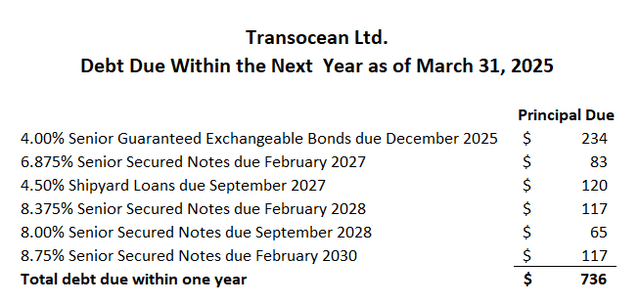
The company listed $263 million of unrestricted cash, $428 million of restricted cash—most of which is reserved for debt service—and an undrawn credit facility with $576 million of capacity. Altogether, its $1.26 billion of available liquidity is more than satisfactory for meeting its near-term debt obligations.
However, if debt markets were to seize up for any reason, Transocean shareholders would be at risk of refinancing long-term debt at a significantly higher interest expense or, at worst, total permanent loss if the company is incapable of refinancing debt when it comes due.
Transocean recently took delivery of two newly built ultra-deepwater drill ships. When these were under construction, they burdened the company’s cash flow through persistently high capex. Now that they’re complete, capex is expected to decline from $717 million, $427 million, and $254 million in 2022 to 2024, respectively, to $115 million in 2025. The reduced capex will free up additional cash flow for debt service.
Even with the higher capex and lower prevailing contract rates, Transocean has successfully reduced its debt burden over the years. Net debt has decreased from $6.1 billion in 2022 to $5.2 billion as of March 31.
Another risk Transocean shareholders have faced stems from dilutive share issuance. The company maintains an at-the-market equity program through which it can issue shares regularly without any announcement. It initially set the program at $400 million in 2021. It is free to expand the program’s capacity at will, and did so in 2022, when capacity was increased to $435 million.
Transocean proceeded to raise $158 million in 2021 and $263 million in 2022. All stock sales were made at depressed prices, assuming the company survives. The 97.1 million shares issued through these at-the-money offerings represented 16% dilution to shareholders.
Shareholders also face dilution from Exchangeable Bonds that Transocean has issued over the years. These bonds will add 120 million additional shares if the bonds are not redeemed.
The chart below shows the increase in Transocean’s diluted share count on a quarterly basis since 2015.
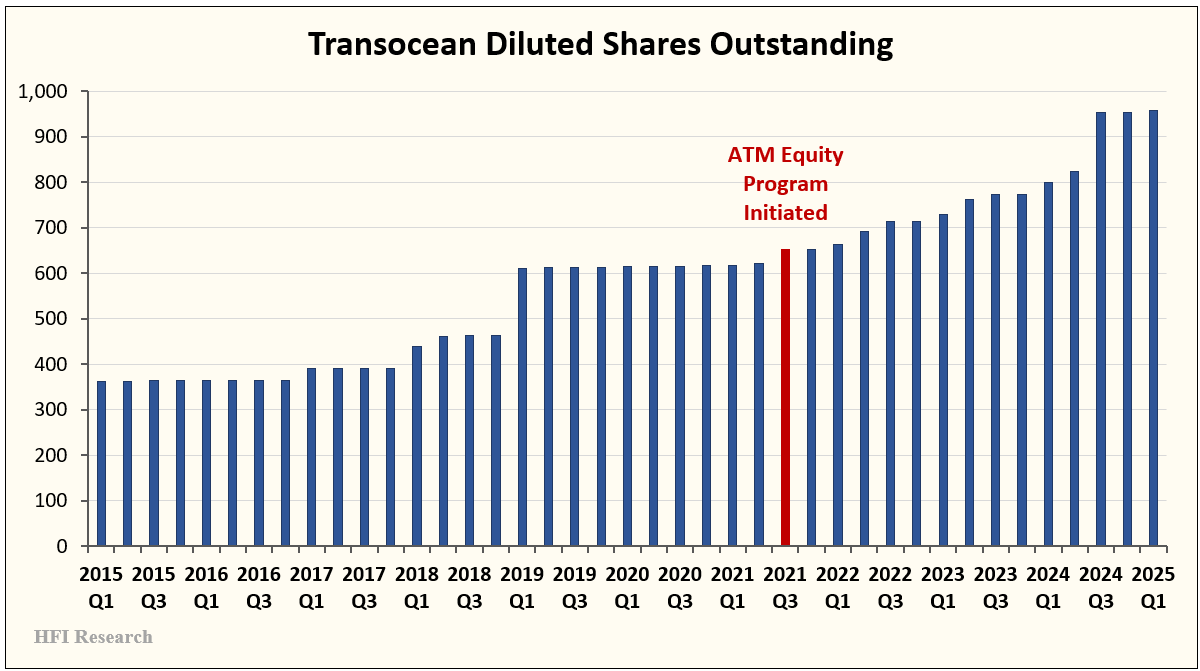
Transocean has shown little hesitation in issuing new equity. While doing so has helped it avoid bankruptcy, additional share issuance is a risk that prospective investors must acknowledge. So far, management has not sworn off new equity issuance.
Transocean is Likely to Survive
Given the increasingly positive tenor for offshore drilling rig supply and demand over the coming years, I expect Transocean to survive. It can most likely do so without additional significant dilution because contract rates on the company’s fleet are set to increase, while at the same time, its capex obligations have decreased.
With that said, there is some downside risk in the near term. At the very least, Transocean’s shares will remain more volatile than those of its peers.
If the global economy entered a severe recession or global capital markets turned ugly, large oil companies could further postpone or curtail their offshore activities, which tend to be time- and capital-intensive. Contract rates for drillships and semisubmersibles could fall, and offshore drillers could find themselves competing with peers for sparse work.
But even in such a challenging environment, I believe Transocean will survive. The risk at that point will turn to dilution rather than debt issues, as the company’s liquidity and the $1.1 billion of EBITDA I estimate it will generate in 2025 will adequately cover its $550 million of annual interest. Transocean is 90% contracted through the remainder of 2025. After $115 million of capex, I estimate that Transocean’s cash flow will cover interest expense by approximately 1.7-times. That’s a bit too close for shareholder comfort, but it provides a meaningful cushion, nonetheless.
Transocean’s survival going forward will be attributable to the same factor that allowed it to avoid a trip to bankruptcy over the past few years, namely, its high-quality fleet.
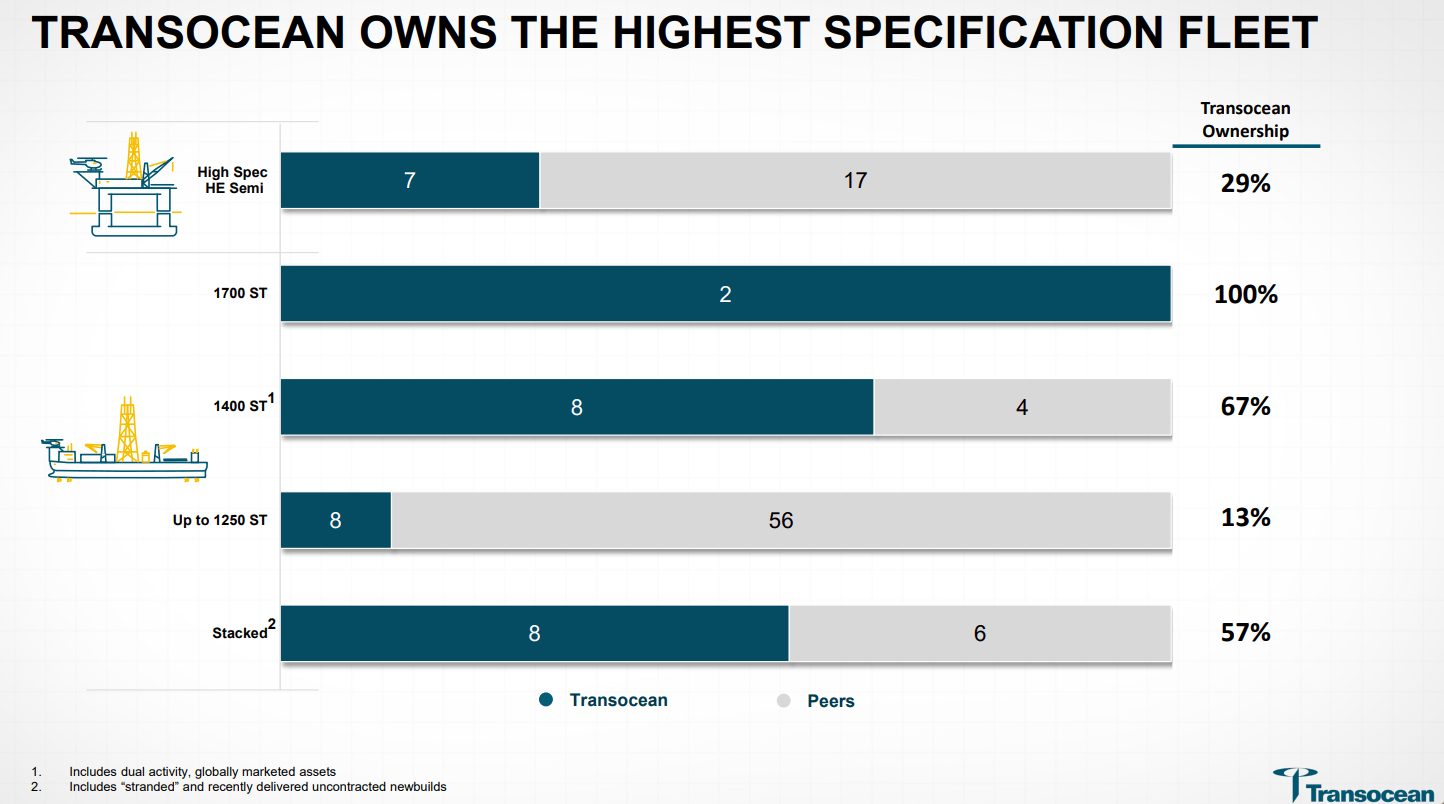
Source: Transocean February 2025 Investor Presentation.
Newer and higher-specification drillships and semisubmersibles—such as those Transocean owns—are preferred in the exploration and development activities of large oil companies because they improve a project’s capital efficiency, primarily by allowing more rapid completion. The high quality of Transocean’s fleet has allowed it to accumulate a contract backlog that towers above its peers, at $7.9 billion.
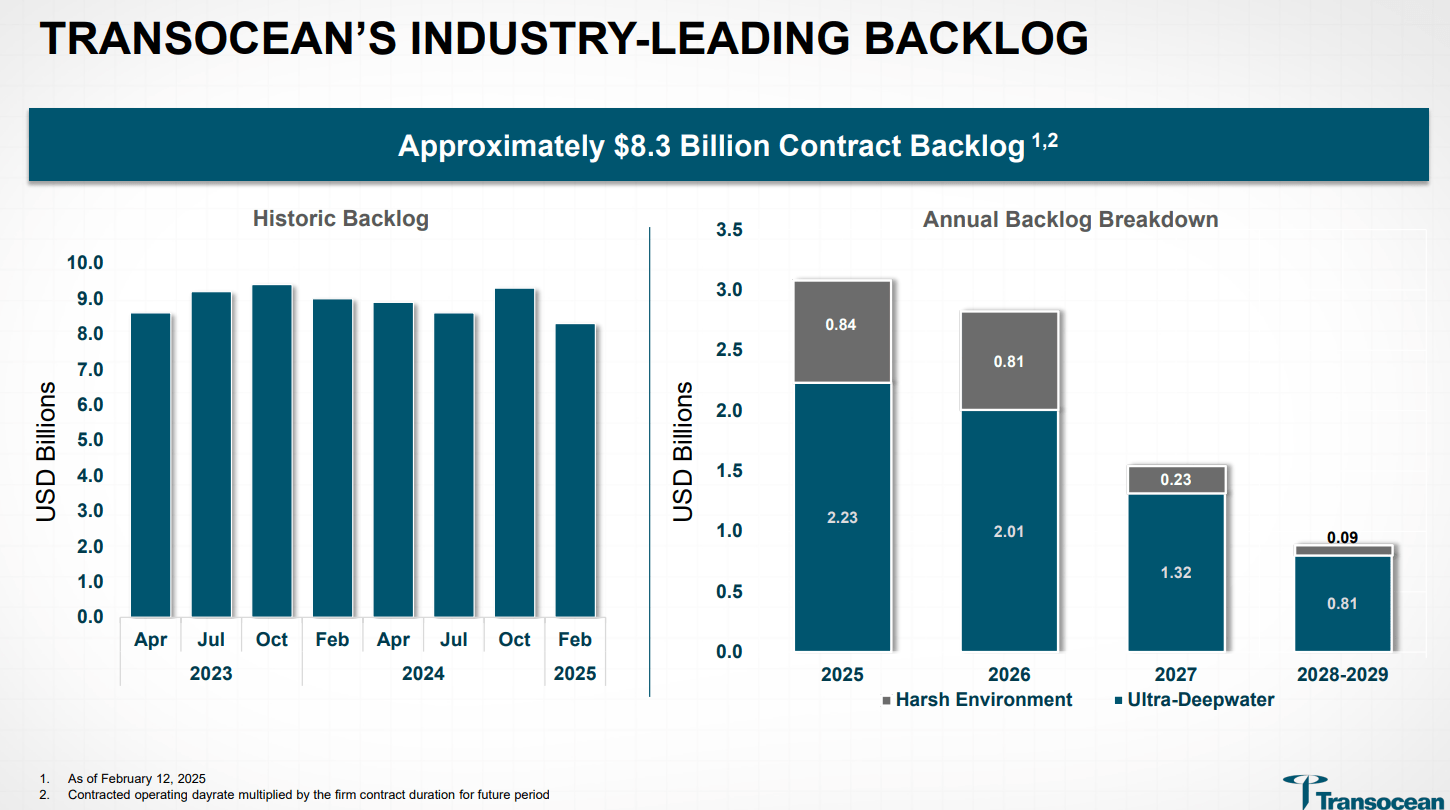
Source: Transocean February 2025 Investor Presentation.
Looking out 18 months and beyond, large oil companies will have to turn offshore if they hope to offset their declining oil production with new discoveries. At that point, competition for floaters and semisubmersibles will return, Transocean’s rigs will command a premium in the market, and the company will likely generate enough cash flow to pay down its debt at a rapid clip.
Upside Prospects
Transocean’s underperformance begs the question of whether it offers investors greater upside than its peers, despite its higher risk.
From a free cash flow perspective, Transocean’s shares appropriately reflect the company’s current daily contract rate, or “day rate.” At the current average day rate of $475,000 for Transocean’s floaters and $425,000 for its semisubmersibles, I estimate it will generate approximately $0.33 per share in free cash flow on a fully diluted share count. Assuming a 12-times multiple, its shares are valued at $2.72, representing 11% upside from their current price of $2.45.
At higher average day rates of $550,000 and $475,000 for floaters and semisubmersibles, respectively, free cash flow increases to approximately $0.90 per share. At a 12% free cash flow yield, Transocean shares would trade at $7.47, implying 205% upside.
In an ultra-bullish scenario where average day rates increase to $650,000 and $530,000 for floaters and semisubmersibles, respectively, Transocean would generate approximately $1.64 of free cash flow, implying a $13.46 share price and 450% upside if the shares traded at a 12% free cash flow yield.
Conclusion
Transocean shares clearly have significant upside in an offshore drilling upcycle. Investors who currently own the name may want to hold in anticipation of the longer-term upside.
Investors allocating new capital are in a different position. I would rather allocate new funds to Valaris than Transocean, if only because I’d expect to sleep better at night knowing there is, (a) less share price volatility, (b) a lower risk of permanent loss in a severe downturn, (c) greater potential of accretive acquisitions and opportunistic share repurchases, and (d) only slightly lower upside in an ultra-bullish day rate scenario.
All in all, Transocean shares are attractive. Like its peers, the company is in the penalty box with investors. I expect that to change over the next few years as the offshore drilling upcycle accelerates. If I’m right, owners of these shares are likely to be richly rewarded.
Analyst's Disclosure: I/we have a beneficial long position in the shares of VAL either through stock ownership, options, or other derivatives.