


By: Jon Costello
The spate of deals in the North American energy patch raises the question of whether producers are scrambling to lock up drilling inventory before it runs out. The latest two deals, announced yesterday, might be read that way.
Nevertheless, I think EQT’s (EQT) proposed all-stock acquisition of Range Resources (RRC), valuing Range at about $13 billion, and Ovintiv’s (OVV) agreement to buy Montney producer Logan Energy (LGN:CA) for about $890 million in cash, have unique rationales. Neither buyer was under pressure to add inventory, while each bought something specific. Operationally, at least, both deals make sense. Whether the prices were right, and whether management delivers, are questions for standalone articles. This is my quick take.
Ovintiv: Oil-Weighted Barrels and Locations Next Door
What is clear is that Ovintiv did not need Logan. When Ovintiv bought Paramount Resources’ Montney assets in 2024, it said the deal extended the life of its premium Montney oil and condensate inventory to approximately 15 years. Logan’s impact is far smaller. It would add approximately 220 additional premium Montney locations, which Ovintiv defines as earning internal rates of return above 35% at $55 per barrel WTI and $2.75 per MMBtu gas. At the company’s 2026 Montney pace of 130 to 140 net wells, Logan would represent roughly 19 to 20 months of drilling. Because the deal is small enough for Ovintiv to fund with cash and existing borrowing capacity, with no new shares, it can be considered a bolt-on, not a necessity.
What Logan offers Ovintiv is the right kind of production and acreage. Its roughly 20,000 boe/d is about 40% oil, condensate, and NGLs, compared with 27% liquids for Ovintiv’s Montney production in the second quarter. Logan’s 7,000 bbl/d of oil and condensate is equal to approximately 8% to 9% of the 80,000 to 85,000 bbl/d Ovintiv expects from the Montney in the second half. Its 266,000 net acres sit in the Montney oil window, including about 200,000 core acres, 80% of which are undeveloped.
That kind of acreage is getting harder to find. Enverus estimates that the Montney’s high-liquids regions hold about 30 years of inventory at current drilling rates, compared with about 90 years for lean gas, and that about 25% of the economic condensate-window inventory changed hands in under 18 months.
Ovintiv also expects to run the assets more efficiently than Logan had. The acreage sits near Ovintiv’s existing operations, and Ovintiv expects to cut more than $2 million from the cost of each well, bringing Logan’s costs in line with its own Montney wells and putting the deal’s total annual cost savings at around $60 million.
Logan also brings two new oil batteries at Simonette, one running and one due by the end of the first quarter of 2027, with 24,000 bbl/d of combined capacity, more than three times its current oil and condensate output, plus stakes in two gas plants. Ovintiv CEO Brendan McCracken says the assets “have demonstrated leading oil productivity performance” and “will immediately compete for capital” with the rest of the company’s portfolio. Ovintiv expects the deal to add about 5% to cash flow per share in 2027 and has left its shareholder-return targets unchanged.
EQT: Adding Scale to Serve Large Buyers
EQT was also not running out of inventory. While the company doesn’t disclose a standalone figure, a third-party analysis by Novi Labs estimated in May that EQT held approximately 18 years of Marcellus inventory, including roughly 15 years of locations that break even below $3.50 per Mcf at its 2026 drilling pace, before counting its Utica acreage. Adding Range would lengthen that runway. EQT says the combined company will have more than 30 years of inventory across nearly 3 million net acres, and that the deal allows it to accelerate development of that inventory into contracted, demand-led growth. The two estimates use different methods, but it is clear that EQT is buying duration to support growth, not scrambling to replace its production.
Nor was Range a distressed seller. It ended June with about $881 million of net debt, and its shareholders will own about 27% of the combined company. CEO Dennis Degner says Range’s board determined that the deal will enhance shareholders’ “ability to participate in a constructive long-term natural gas and NGL macro outlook.”
More importantly, the addition of Range allows EQT to build scale. Range produced 2.30 Bcfe/d in the second quarter, approximately one-third of EQT’s roughly 7 Bcfe/d, bringing the combined company to more than 9 Bcfe/d. EQT says the deal will give it the largest natural gas marketing platform in the U.S., with more than 10 Bcf/d of marketing capacity, more than 3,700 miles of pipelines and more than 40 Bcf of gas storage, along with an unlevered free cash flow breakeven below $2 per MMBtu.
Scale and duration will allow EQT to better serve the large natural gas buyers prized by gas-weighted E&Ps. In July, EQT reported a 10-year agreement to supply 325,000 Dth/d to Competitive Power Ventures’ new 2-gigawatt Shay Energy Center in West Virginia, priced off PJM power prices, and a five-year LNG offtake agreement with a large Asian integrated energy company for 0.5 million tonnes a year starting in 2028. These buyers want a supplier that can commit large volumes for a decade or more, and Range will add both the volumes and the years.
Range also brings more liquids-rich production, although the combined company will still be approximately 88% gas. Range expects liquids to exceed 30% of its 2026 production, and in the second quarter it realized a record NGL premium of $3.49 per barrel over Mont Belvieu, which it attributed to access to international markets. EQT expects $325 million of annual cost and marketing benefits within two years, with a path to more than $600 million that includes wider marketing margins.
Rational Consolidation
When compared side by side, these two deals have little in common beyond their announcement date.
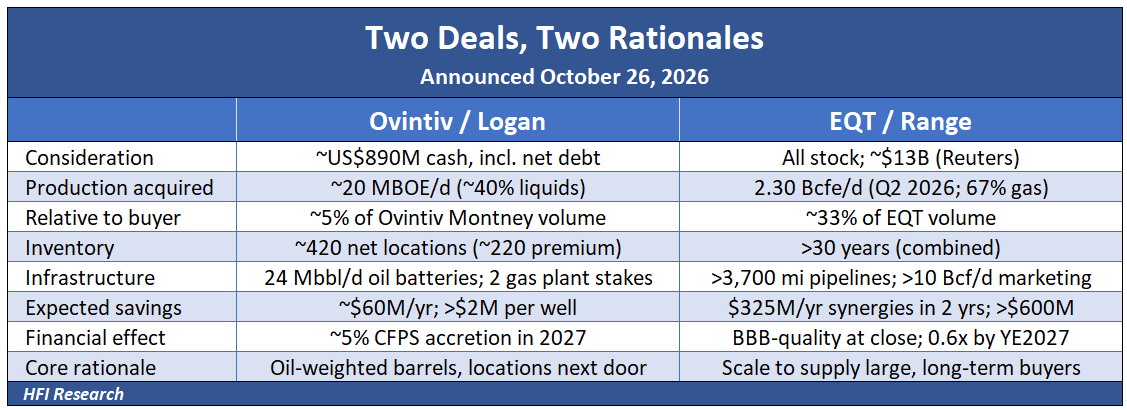
Ovintiv bought oil-weighted production and premium oil-window locations next to infrastructure it already operates. EQT bought scale, inventory duration, liquids exposure, and the capacity to commit supply to large, long-term customers. Neither buyer was running out of inventory, and both had conservative balance sheets, with Ovintiv expecting net debt below $4 billion after closing, and EQT expecting BBB-quality credit metrics at closing and leverage of 0.6x by the end of 2027.
That makes this round of consolidation rational, at least from an operational perspective. Price and execution are open questions. EQT is paying a 20.6% premium and Ovintiv is paying approximately $1.5 million per premium location. Whether the promised savings arrive will determine whether either price was justified, and I will take those questions up in separate articles.
My view is that operating logic, not fear of running out of inventory, drove both deals. More deals may follow, but I don’t regard these deals in themselves as a signal of a looming consolidation wave.
Link to HFIR Energy Income Portfolio on RunPlutus.
Analyst’s Disclosure: I/we have a beneficial long position in the shares of EQT and RRC either through stock ownership, options, or other derivatives.