


By: Jon Costello
The following is an excerpt of a letter I wrote to investors in an investment partnership I manage. It is the first of two parts. The second part will address consequences to the oil and stock markets.
More than five months after the Strait of Hormuz was first closed, the global oil market is confronting a supply disruption unlike anything in modern history. Yet crude prices continue to reflect a market that appears remarkably unconcerned. I believe that complacency is misplaced. The shortage has so far been masked by massive inventory withdrawals, strategic reserve releases, sharply reduced Chinese imports and lower refinery runs—temporary buffers that are increasingly being depleted. In this first of two parts, I examine why I believe the physical oil market is considerably tighter, and the risk of substantially higher prices considerably greater, than current crude prices suggest.
The Largest Oil Supply Disruption on Record Is Underway
The closure of the Strait of Hormuz—the chokepoint through which roughly one-fifth of the world’s petroleum liquids normally passes—has produced the largest oil supply disruption ever recorded, well above the previous record of roughly 3.5 million barrels per day seen in 1974 during the Arab oil embargo.
The magnitude of the ongoing inventory draw is difficult to overstate. Saudi Aramco estimated on August 4 that the conflict had removed roughly 11 million barrels per day of liquid supply, with much of that loss temporarily absorbed through strategic reserve releases, commercial inventory withdrawals, and regional demand reductions.
More important for assessing the damage already done, Aramco estimated that rebuilding depleted inventories could require approximately 2.1 million barrels per day of surplus supply for up to 18 months. That implies a cumulative inventory loss of roughly 1.15 billion barrels. Because that depletion occurred over approximately five months, it equates to an average inventory draw of about 7.6 million barrels per day.
The scale of the disruption becomes clearer when contrasted with the largest oil supply deficits of the past half-century, presented in millions of barrels per day (mb/d).
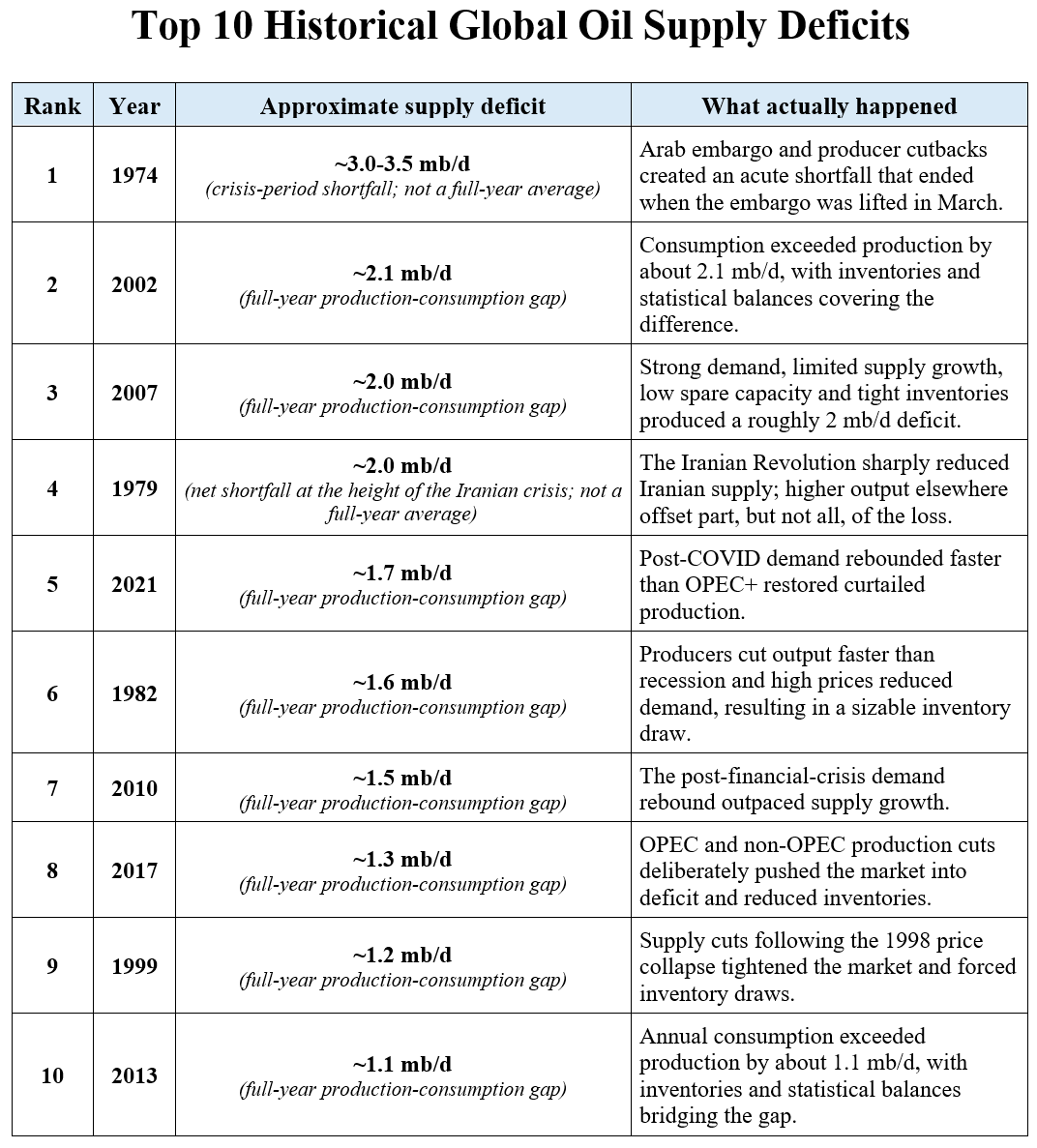
Factoring in temporary offsets to the supply loss, the net effective supply deficit is roughly 3 to 4 million barrels per day, placing the disruption in the same range as the 1974 Arab oil embargo.
However, that comparison understates the risk. Much of today’s shortage has so far been absorbed through extraordinary withdrawals from commercial inventories and strategic reserves, along with reduced Chinese imports and other forms of demand management. Those buffers are finite. As they are depleted, even an unchanged or reduced supply deficit becomes progressively harder for the market to absorb. Unless additional production reaches the market or demand falls further, an increasing share of the adjustment will have to come through higher oil prices.
Why I Believe Oil Remains Underpriced
Oil prices remain well below the levels implied by the ongoing supply disruption. Oil futures prices reported in the financial media reflect market conditions almost exclusively in the here and now. Most contracts expire within a few months, so traders holding them are largely indifferent to market-moving events beyond that horizon. This structure explains how oil futures can trade as if the crisis were resolved while the physical market’s supply/demand balance tightens by the week.
While near-term futures prices can be a useful gauge of immediate supply and demand, oil’s “fair value” is more reliably gauged by the relationship between prices and inventories. That relationship is nonlinear, as prices tend to rise at an accelerating rate as inventories fall.
By early August, the global oil market had lost well over one billion barrels of inventory, depleting roughly 14% of the inventory that existed before the conflict. The supply deficit shows no signs of abating, while tankers and onshore oil infrastructure are now repeatedly being attacked across the Middle East. Yet WTI remains in the low-$80s—only about 20% above its prewar level. The disconnect between the physical oil market and oil prices remains remarkable.
Statistical fair-value models that I believe are reliable currently place WTI’s fair value above $100 per barrel, implying a gap between price and fair value of 30% to 40%, at the extreme of historical deviations. Moreover, as inventories continue to fall while prices remain in a narrow range, the gap widens.
Four visible factors explain why prices have been unable to mount a sustained rally.
First, governments have released large volumes of oil from strategic reserves. Those releases have been effective in offsetting supply losses. Consider that of the 62 million barrels removed from developed-country inventories in June, 44 million came from strategic reserves rather than new production. Strategic reserves are a finite resource, and their usable capacity is being rapidly depleted.
Second, computer-driven funds, which account for a large share of futures trading, reduce exposure automatically when volatility rises, regardless of the physical supply-demand balance.
Third, the market has repeatedly valued negotiations as though they had already succeeded.
The fourth factor is massive selling of crude futures by unidentified parties. Short positioning in the futures market is at historic highs even as the physical market is experiencing the most severe oil supply disruption on record. I have rarely seen such an extreme divergence in all my years participating in markets. One possible explanation is that government-affiliated funds are selling crude futures to suppress prices and limit the economic damage that would result if oil rose to levels more consistent with current supply risk and inventory-depletion trajectories. I want to emphasize, however, that this is my suspicion rather than a conclusion supported by direct evidence.
Suppressed prices have consequences. If oil prices are held below the level required to balance supply and demand, the effect can resemble a price control, since the shortage is not resolved, producer and consumer adjustments are delayed, and the eventual correction can become more severe.
During a supply crisis, high oil prices perform an essential economic function. They encourage additional production, discourage marginal consumption, and force conservation. Preventing that price signal from doing its work does not eliminate scarcity; it merely postpones the adjustment. If the current path continues, I believe outright physical shortages are increasingly likely.
A Deal Has Been Priced In Repeatedly, but Never Delivered
Oil’s underpricing has been repeatedly reinforced by U.S. jawboning since the crisis began. Over and over, threats of imminent military escalation have been followed by postponements, ceasefires, or claims of progress in negotiations, sending crude prices sharply lower and inflicting losses on traders positioned for a tighter physical market.
Since March, some version of the same jawboning sequence has occurred at least eight times:
March 21–26: The U.S. threatened to “hit and obliterate” Iranian power plants unless Hormuz reopened within 48 hours. The strikes were postponed two days later amid claims of “very good and productive” negotiations, and the deadline was subsequently extended by another 10 days.
April 7: The U.S. warned that “a whole civilization will die tonight.” Hours later, a two-week ceasefire was announced to provide time to conclude a proposed 10-point plan.
April 21: The president said he expected the U.S. “to be bombing” if talks failed. Later that day, the ceasefire was extended indefinitely after mediators requested more time.
May 17–18: The U.S. warned that “the Clock is Ticking,” then held off a major strike at the request of Qatar, Saudi Arabia, and the UAE, citing “serious negotiations.”
June 11: The president said the U.S. would hit Iran “VERY HARD TONIGHT.” The operation was canceled hours later after another claimed negotiating breakthrough.
June 14: The U.S. and Iran announced a 60-day framework that included a ceasefire, the lifting of the U.S. naval blockade, and the reopening of the Strait. Almost immediately thereafter, oil gave back its war premium.
July 27: The bombing campaign was paused to give diplomacy another opportunity.
August 1: The U.S. declared that it was “locked and loaded,” then canceled a planned attack after claiming that Iran had agreed to the parameters of a deal.
In the end, none of these threatened strikes, ceasefires or purported negotiating breakthroughs has produced a sustained increase in oil flows through the Strait of Hormuz. The details have varied, but the pattern has been remarkably consistent: a deadline is announced, military action appears imminent, negotiations are said to be advancing, and the deadline is then postponed. All the while, Iran has repeatedly disputed the suggestion that meaningful negotiations are underway. Even in July, when the two sides appeared closest to an agreement to reopen two shipping lanes, Iran’s senior negotiator publicly dismissed the prospect of a deal, saying, “Don’t even think about it.”
Iran continues to throttle oil flows through the Strait of Hormuz. At present, flows are running at less than 5 million barrels per day, down from more than 20 million barrels per day before the conflict and from a brief surge to roughly 15 million barrels per day in June. Much of that surge was attributable to Iranian tankers exiting after the U.S. temporarily eased its blockade of Iranian commerce.
More than five months after the Strait first closed, satellite tanker-tracking firm Kpler estimates traffic remains at just one-quarter of its prewar level.
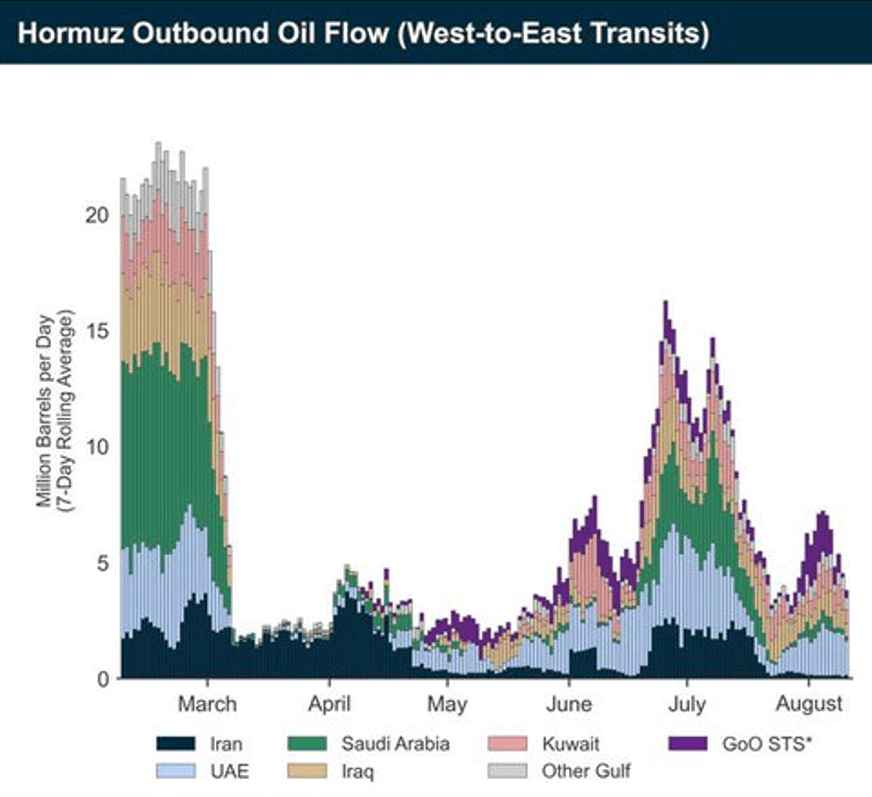
Source: Rory Johnston, Kpler, X, Aug. 11, 2026.
Kpler’s estimates should not be treated as precise, and actual oil flows through Hormuz may be higher than the figures shown above. But the estimated shortfall is so large that I do not believe any plausible measurement difference could eliminate it. Even if Kpler is materially understating current flows, they would still have to be several multiples higher than its estimates to erase what remains a significant global supply deficit.
For the oil market to begin returning to anything resembling its prewar normality, flows through Hormuz will have to increase substantially from current levels.
Iran’s Demands Are Hardening
Which brings me to the present day. Iran’s negotiating position appears to be hardening, and its demands now go far beyond simply ending the conflict. Tehran is now demanding:
The withdrawal of U.S. military forces from the region.
A permanent end to the U.S. war against Iran.
An end to U.S. military action against Iran’s regional allies in Lebanon, Palestine, Yemen, and Iraq.
No further U.S. military threats against Iran.
An end to the U.S. naval blockade of Iranian ports.
The lifting of U.S. sanctions against Iran.
The unconditional release of Iran’s frozen foreign assets.
Full compensation for war damage.
Iran’s parliament is also considering barring ships from hostile countries, including the United States and Israel, from transiting Hormuz until those countries compensate Iran for war damage.
These are not the demands of a government urgently seeking a deal. They suggest Tehran believes its bargaining position is strengthening and that time is working in its favor.
My read is that Iran understands where much of that leverage comes from: oil. Hormuz does not have to remain closed indefinitely for Iran to benefit. Disruption merely has to persist long enough to tighten the market and push oil prices materially higher. The higher prices rise, the greater the economic cost imposed on Iran’s adversaries and the stronger Tehran’s negotiating position becomes.
The Strait of Hormuz Is Iran’s Real Deterrent
Iran’s greatest strategic victory may ultimately have little to do with the terms of whatever agreement ends the conflict. It may instead come from convincing the United States, Israel and the rest of the world that disrupting Hormuz represents a powerful economic deterrent. If military action against Iran credibly threatens sharply higher energy prices, oil shortages, renewed inflation and potentially a global recession, the cost of intervention rises considerably.
That possibility could force the U.S. and Israel to think much more carefully before undertaking future military action. In that sense, the ability to disrupt Hormuz could ultimately prove more valuable to Iran than a nuclear weapon, which would be extraordinarily difficult to use without inviting catastrophic retaliation.
Influence over a critical artery of the global oil market, by contrast, can be exercised in degrees, repeatedly and without crossing the nuclear threshold. Whether Iran can establish such a deterrent remains to be seen. Still, I increasingly believe that demonstrating the economic power of the Strait of Hormuz has become one of Tehran’s most important strategic objectives.
The Supply Disruption Has Spread Beyond Hormuz
The more recent problem is that the disruption is no longer confined to the Strait of Hormuz.
On July 20, the Houthis entered the conflict, opening a second front against oil flows through the Bab el-Mandeb Strait at the southern end of the Red Sea. This is particularly important for Saudi Arabia. With Hormuz impaired, the Saudis have been forced to divert more than 70% of their normal crude exports to the Red Sea port of Yanbu, from which barrels destined for Asia must travel south through Bab el-Mandeb. Saudi crude and refined-product shipments from Yanbu have averaged more than 4.5 million barrels per day since April, with roughly 70%—more than 3 million barrels per day—bound for Asia. The Red Sea route has therefore become Saudi Arabia’s principal means of maintaining exports. At the same time, Hormuz remains impaired, yet even these flows amount to only about half of the Kingdom’s pre-conflict output.
Houthi attacks and threats have now placed those barrels at risk as well. Kpler measured Saudi crude transiting Bab el-Mandeb falling from roughly 3 million barrels per day before the attacks to about 1.5 million barrels per day immediately afterward. I would therefore characterize more than 3 million barrels per day of Saudi supply as newly exposed to disruption or costly rerouting, with roughly 1.5 million barrels per day initially displaced. Those barrels are not necessarily lost. Some cargoes can be redirected north through the Suez Canal or around Africa, but doing so adds time, freight costs, and logistical constraints precisely when the global oil market has little remaining capacity to absorb another disruption.
The threat to oil supply has also spread beyond these two critical shipping lanes. On July 27, Iran-backed militias launched drones at Saudi oil facilities in the Eastern Province, including the Abqaiq area, home to the world’s largest crude-oil processing complex. Kazakhstan’s output was cut roughly in half in late July after drone attacks shut the Caspian Pipeline Consortium’s Black Sea terminal, removing approximately 900,000 barrels per day. Inside Russia, Ukrainian drones have struck nearly half of the country’s refining capacity at least once since April, while fuel rationing now affects roughly 50 million people. None of these disruptions would be resolved simply by an agreement between Washington and Tehran.
The significance for the oil market is cumulative. Each new disruption removes another layer of redundancy from the global supply system, forcing barrels onto longer routes and leaving less logistical capacity to absorb the next shock. With inventories already heavily depleted, even modest additional losses could disproportionately affect prices.
The Global Oil Supply Buffer Has All but Disappeared
Before the Iran war, global oil inventories totaled approximately 8.4 billion barrels. Still, much of that oil was working inventory required to keep pipelines, refineries, terminals and the broader distribution system operating.
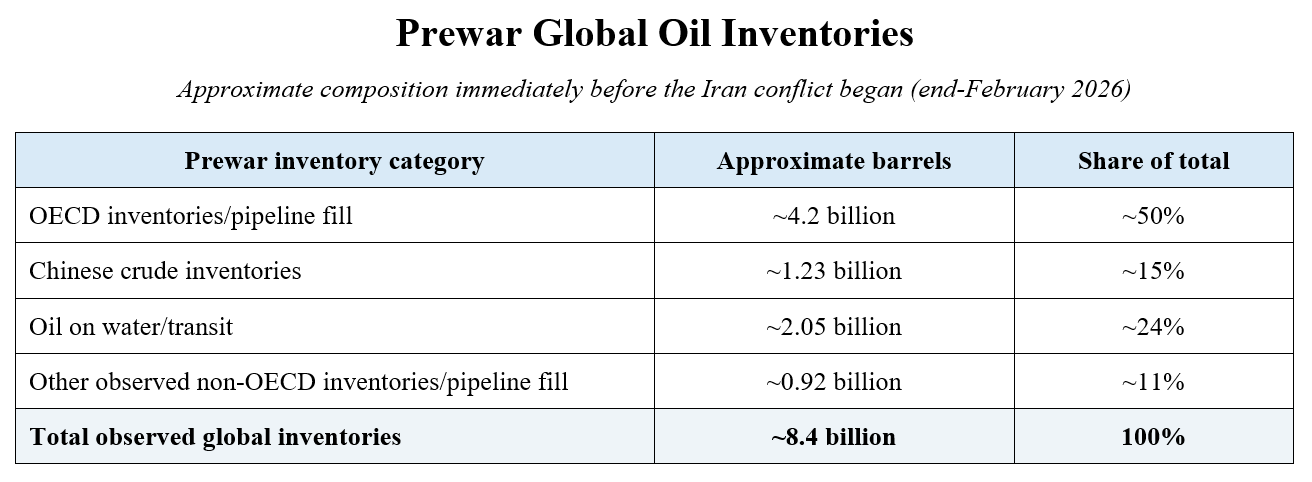
Source: J.P. Morgan estimates.
Moreover, that headline inventory figure substantially overstates the cushion that was actually available when the war began. At the IEA’s current estimate of 103.3 million barrels per day of 2026 demand, 30 days of consumption amounts to approximately 3.1 billion barrels. But even that understates the amount of inventory effectively tied up in the system.
J.P. Morgan estimated before the war that only about 800 million barrels of the 8.4-billion-barrel total could be drawn without creating operational stress, implying an effective operating floor of roughly 7.6 billion barrels.
On this framework, global inventories have fallen from roughly 8.4 billion barrels before the war to approximately 7.25 billion barrels today. The table below shows estimated inventory depletion since the conflict began.
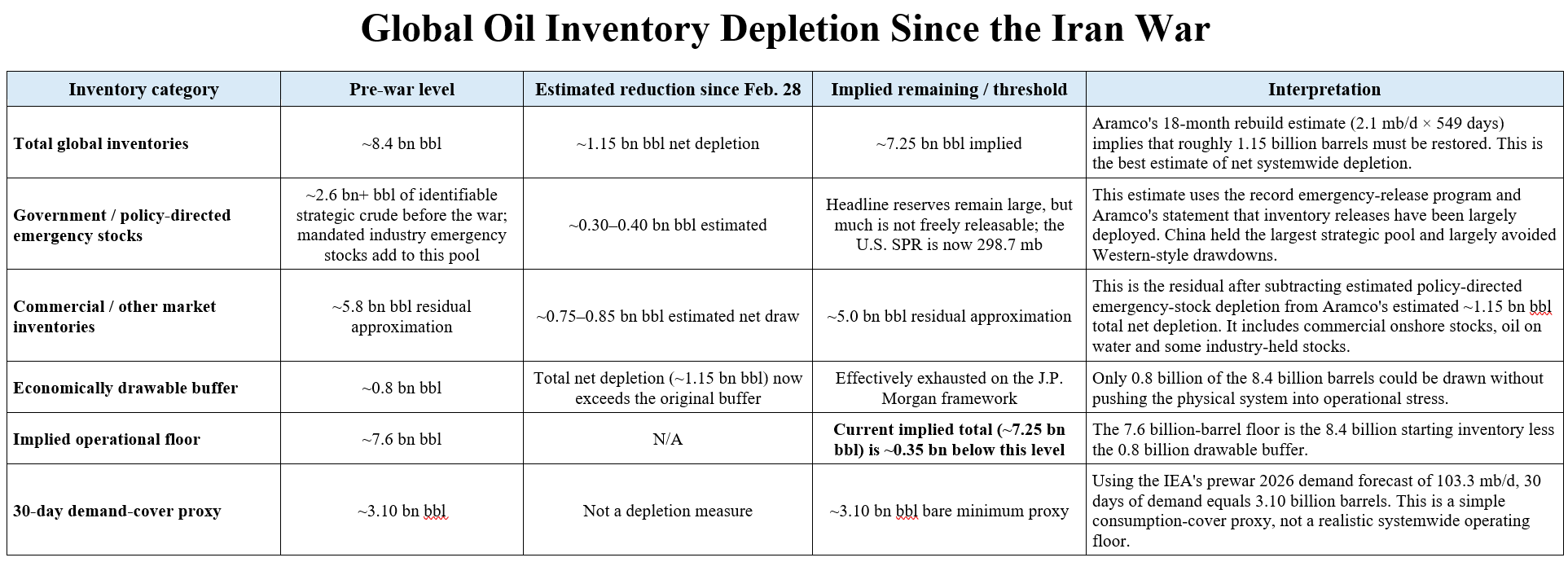
Sources: IEA, EIA, OPEC, Saudi Aramco, MUFG, J.P. Morgan, and Goldman Sachs.
That depletion puts the system below the roughly 7.6-billion-barrel level implied by J.P. Morgan’s estimate of how much inventory could be drawn before operational stress begins to emerge.
The remaining barrels are not equally available: much of the strategic reserve pool is constrained by policy and national security considerations, while commercial inventories include working stocks needed to keep refineries, pipelines and terminals operating normally. In other words, the market is no longer drawing primarily from excess inventory. It is increasingly consuming the operating cushion itself. That is why further depletion could have consequences disproportionate to the number of barrels lost, including greater regional tightness, logistical disruptions and more volatile prices.
What is clear is that if the current supply deficit persists for a few more months, the market will increasingly lose access to the inventory buffers that have so far prevented the shortage from being fully reflected in prices. Commercial stocks cannot be drawn indefinitely without approaching the minimum levels needed to keep refineries, pipelines and distribution systems operating. At the same time, the usable portion of strategic reserves will be exhausted well before the headline SPR balances reach zero.
As inventories approach those limits, futures prices can become less informative as a measure of immediate physical scarcity. Refiners and consumers ultimately need actual barrels, not paper contracts, and increasingly scarce physical supply can command premiums that are not immediately reflected in the futures market.
The result is a considerably more fragile market. The marginal barrel can no longer come from storage, leaving additional production or further demand destruction as the primary mechanisms for balancing supply and demand. If new supply cannot arrive quickly enough, prices will have to rise to levels that force that demand out of the market. The risk, therefore, is not simply that the present shortage continues, but that its effect on prices becomes increasingly nonlinear as the inventories masking it disappear.
China’s Return Could Tighten the Market Further
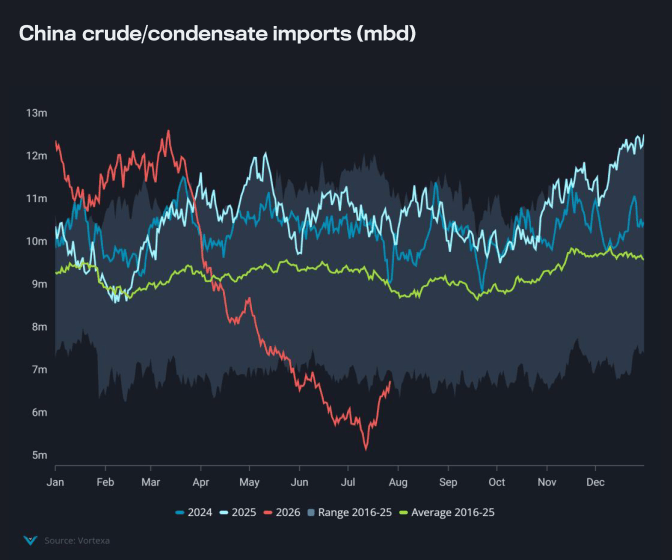
China has been one of the most important buffers preventing the physical oil shortage from becoming even more severe. Its crude imports averaged just 7.78 million barrels per day in June and July, compared with 11.99 million barrels per day before the conflict. In June alone, imports fell to 6.2 million barrels per day, their lowest level since November 2015.
China did not suddenly stop needing oil. It reduced imports, drew down inventories accumulated earlier, and curtailed refinery activity, effectively substituting stored barrels and lower consumption for roughly 4.2 million barrels per day of imports.
Source: Barclays Research, EIA, Kpler, July 27, 2026.
That strategy has bought time, but it cannot continue indefinitely. At a 4.2-million-barrel-per-day reduction in imports, every 100 million barrels of usable Chinese inventory offsets only about 24 days of purchases. Deferred demand is not destroyed demand. As inventories decline, China must eventually choose between deeper consumption cuts and a return to the seaborne crude market.
Signs of this process are already emerging, with Chinese crude imports recovering from their June low, as shown in the following chart.
Source: Vortexa, August 7, 2026.
This return could accelerate just as Western governments become less able to supplement supply from strategic reserves, intensifying competition for the barrels still available to the market.
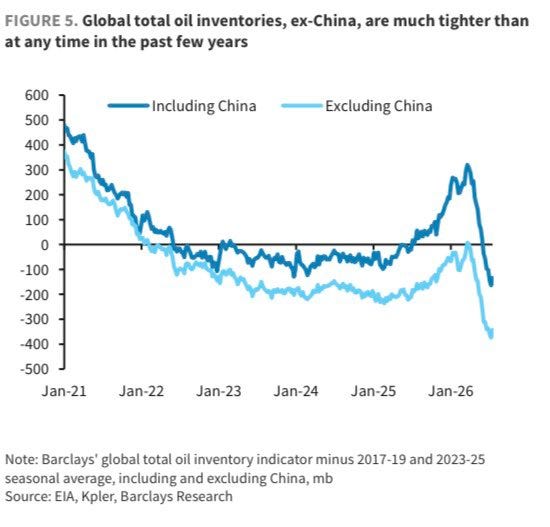
If China continues restoring crude purchases toward pre-conflict levels, it could materially tighten an already depleted global oil market. Excluding China, global inventories are approximately 370 million barrels below their seasonal average, the tightest reading in five years. As China returns as a major buyer, competition for the marginal barrel will intensify.
China’s return could make the price response even more nonlinear. With commercial inventories moving closer to operating minimums and usable strategic reserves shrinking, the market has much less capacity to absorb additional demand or another supply disruption without an immediate price response. Price spikes and regional shortages therefore become more likely even if the headline global supply deficit does not worsen. The same supply deficit has a much greater effect when fewer stored barrels remain available to cushion it.
China’s return would therefore matter not because its demand is new, but because deferred demand would re-enter a market with far less inventory to cushion it.
Reduced Chinese refinery activity has also helped temporarily suppress crude demand. With Chinese runs sharply curtailed, global refinery runs are roughly 6 million barrels per day below year-ago levels in a market consuming approximately 103 million barrels per day. Yet demand for petroleum products has not fallen nearly as much. The result has been sharply higher prices for gasoline, diesel, and jet fuel while crude prices have remained comparatively subdued. These are observable physical developments, including in satellite data to which I have direct access. Oil futures prices do not yet reflect the degree of tightening visible in the physical market.
Taken together, these developments show how the market has managed the shortage so far: by drawing inventories, releasing strategic reserves, suppressing Chinese imports and reducing refinery runs. None of those responses can continue indefinitely. The more important question, then, is what happens as those buffers are depleted and the shortage begins to work its way more fully into oil prices, the economy and financial markets.
Conclusion
The key point is not that the current supply deficit must grow for oil prices to rise substantially. It is that the mechanisms that have prevented the existing shortage from being fully reflected in prices are being exhausted. Inventories have already been drawn deeply into the system’s operating cushion, strategic reserves are finite, China is beginning to return to the market, and the threat to supply has spread well beyond the Strait of Hormuz. As those buffers disappear, the same supply deficit can have a much greater effect on prices, making the adjustment increasingly nonlinear.
In Part II, I will turn to what that adjustment could mean for the economy and the stock market, and why an oil shortage of this magnitude could ultimately have consequences extending far beyond the energy markets.
Link to HFIR Energy Income Portfolio on RunPlutus.
Analyst’s Disclosure: I/we have a beneficial long position in the shares of the HFI Research Energy Income Portfolio either through stock ownership, options, or other derivatives.