

By: Jon Costello
Today, I want to focus on portfolio policy rather than new investment ideas or updates on existing holdings. Attractive investment candidates have become worrisomely scarce, and I have begun raising cash in the HFIR Energy Income Portfolio. This article explains why.
Portfolio Management Update: When the Opportunity Set Deteriorates
I am having difficulty finding stocks I want to buy. That does not mean my research process has stopped working. Rather, it reflects the state of my current opportunity set. Much of the market has risen to fair value or beyond, while many securities that still look statistically cheap are cheap for understandable reasons, including weak businesses, poor balance sheets, questionable management, or industries facing structural decline. A low multiple is not a margin of safety. Treating the two as interchangeable is how investors mistake apparent cheapness for genuine value.
Until recently, the opportunity set was much broader. Over the past year, I found and invested in attractive opportunities in offshore drilling, coal, chemicals, biofuels, healthcare, payments, retail and other areas. Today, I cannot identify a sector I know well that appears broadly undervalued. Company-specific opportunities have become scarce as well. This judgment reflects not only current valuations, but also the risks I see facing the economy, the broader market, and individual companies. Once I incorporate those risks into my intrinsic-value estimates, very few securities offer the margin of safety I require.
Deep-value investors—particularly those focused on cyclical industries—can become especially vulnerable when genuine bargains are scarce. Screens still produce apparently cheap names, but the quality of the available candidates is deteriorating. The temptation is to lower the hurdle, invent a catalyst, or make a short-term price movement the thesis. That pressure is especially acute for anyone writing publicly about investing. Eventually, disciplined investing can quietly become speculation. I have made that mistake before, and the lesson was expensive.
As long-time readers know, I prioritize investment returns above all else. My objective is to buy a business for less than a conservative estimate of its worth, with a credible path for that value to be realized and, ideally, increased over time—not simply to own whatever looks cheapest today. I am willing to own cyclical and out-of-favor companies and tolerate volatility and concentration, but those risks must be compensated by price, balance-sheet resilience, and favorable long-term economics.
What the Market is Pricing
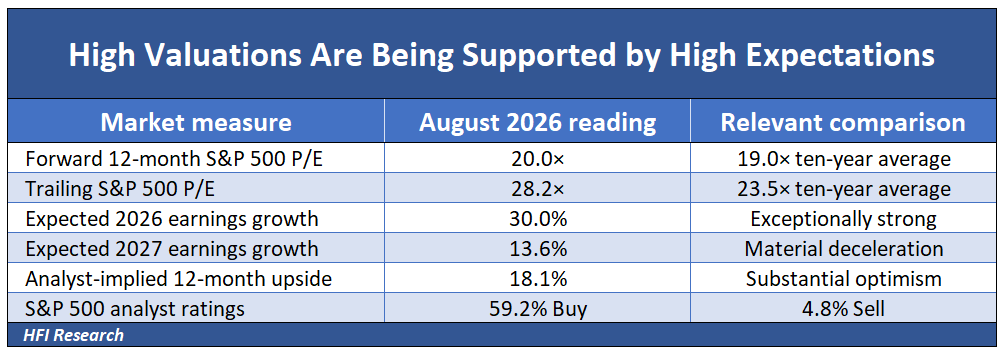
I acknowledge that today’s bullish sentiment rests on genuine economic strengths. Corporate earnings are strong, supported by improvements in productivity, technology, and profitability. In early August, FactSet reported that the S&P 500 traded at about 20x expected earnings for the next twelve months—above its ten-year average—while analysts expected unusually rapid growth through the remainder of 2026. The bullish case is straightforward: pay a full price today because future earnings will justify it.
The problem is not that this outcome is impossible, but that much of it is already assumed. At elevated valuations, investors are paying for current earning power and the continuation of favorable margins, growth, financing conditions, and confidence. There is little room for disappointment. Strong businesses can be poor investments when their prices capitalize unusually good conditions too far into the future.
Profit margins make that assumption especially important. FactSet’s August 7 Earnings Insight put the S&P 500’s blended second-quarter net margin at 16.9%—the highest since its series began in 2009, versus 14.8% in the prior quarter and a five-year average of 12.4%. Alphabet and Amazon contributed unusually large EPS surprises, but excluding them still left a record 15.0%. The strength was broad: nine of eleven sectors exceeded their five-year averages, including Communication Services at 28.5% versus 13.0%, Consumer Discretionary at 16.4% versus 8.0%, and Information Technology at 31.6% versus 25.6%. High margins may persist, but paying a high multiple on record profitability offers less protection if competition, wages, input costs, taxes, or financing expenses press them lower.
After sustained outperformance, investors are tempted to capitalize today’s unusually high margins as though they will remain elevated indefinitely rather than revert toward historical norms. This creates a high risk of permanent capital loss. If margins—and perhaps return on invested capital—decline, earnings can fall as valuation multiples contract. Profitability and returns on capital may take years to recover to current levels, if they ever do.
Longer-term measures tell a similar story. Robert Shiller’s cyclically adjusted price-to-earnings ratio, which compares price with ten years of inflation-adjusted earnings, is near the upper end of its historical range.
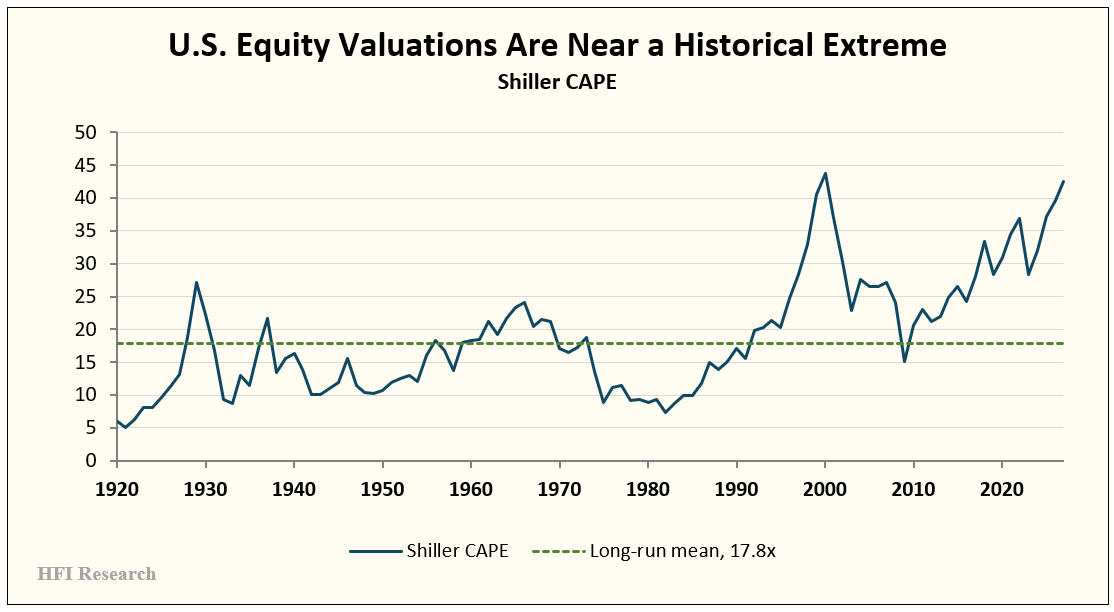
CAPE is not a timing device; an expensive market can remain expensive. Its message is humbler: starting valuation influences the range of plausible long-term returns. Paying more makes the result more dependent on earnings growth actually arriving.
The CAPE series is volatile, and I do not treat it as a short-term signal. Still, rapid increases have often been followed by substantial declines. I am willing to forgo additional upside if doing so reduces exposure to a subsequent drawdown.
A Portfolio Decision, Not a Prediction
I do not pretend to know what the market will do over the next few years, and I am not positioning around a precise forecast. Expensive markets to not need to fall; they can move sideways while earnings catch up or continue rising. Nevertheless, today’s valuations and scarcity of company-specific bargains make outsized broad-market returns less likely, in my judgment, and a defensive posture rational.
I expect meaningful drawdowns at some point over the next eighteen months, although I cannot know their timing or cause. A surge in oil prices could be one catalyst; shifting interest-rate expectations, an earnings disappointment, or an unforeseen event could be another. The trigger matters less than the portfolio’s ability to endure it. A sound plan should not require advance knowledge of the headline that changes sentiment.
Meaningful declines are not infrequent over stock market history. Fidelity calculates that the S&P 500 experienced a drawdown of at least 10% in nearly half of all calendar years from 1980 through 2025. J.P. Morgan’s figures show that the index’s average intra-year decline since 1980 has been approximately 14% and its median decline 10%, even though stocks finished higher in roughly three-quarters of those years. Capital Group estimates that declines of at least 10% have occurred about once every eighteen months since 1954, while bear-market declines of 20% or more have occurred about once every six years. This history cannot tell us when the next selloff will begin, but it shows that drawdowns are a recurring feature of equity ownership.
Cash and high-quality fixed income should not be viewed merely as assets that failed to keep up with a bull market. They provide stability, income, and—most important for an active value investor—the capacity to act when prospective returns improve. Cash has option value without an expiration date, but only if one exercises it when fear returns and prices become dislocated.
Graham’s Useful Default
I recently re-read Benjamin Graham’s The Intelligent Investor. His policy for the defensive investor remains a useful starting point in today’s market. In the book, Graham proposed dividing funds between high-grade bonds and leading common stocks, normally about 50% each, while allowing stocks to range from 25% to 75% and moving bonds inversely. The framework was deliberately simple, designed to keep investors from becoming fully committed to stocks after a major rise or abandoning them after a major decline.
The policy’s enduring virtue is behavioral rather than mathematical. A 50%/50% allocation is not optimal for everyone, since tax circumstances, liabilities, and income needs vary by investor. Graham’s central insight nevertheless retains its force. Portfolio policy should impose discipline when emotion and recent performance argue for the opposite. Rebalancing requires an investor to sell some of what has become dear and buy what has become cheap.

In the current environment, the 50%/50% default strikes me as wise. It does not mean selling every stock, hiding in cash, or pretending bonds carry no risk. Asset allocation should respond to prospective returns and available opportunities, not fear of looking inactive. For individual clients, the exact mix must reflect liquidity needs, taxes, risk tolerance, and the durability of their capital. The principle matters more than applying the same percentage to every account.
Why I Reduced My Calumet LEAPS Positions
That framework helps explain a recent portfolio decision. Last week, I lightened up on a substantial position in Calumet (CLMT) LEAPS in client accounts, purchased when the common stock traded in the single digits. I have not sold any CLMT common-stock holdings and plan to hold the shares for the long term, as long as the thesis remains intact.
LEAPS can magnify returns, but they introduce leverage, time-decay risk, and a finite expiration date. As the underlying stock appreciates, a position initially sized for an asymmetric opportunity can become a much larger source of portfolio risk. Reducing that exposure harvested gains, locked in satisfactory returns, lowered time-sensitive leverage, and raised substantial cash for opportunities that may emerge in a selloff—including one caused by an oil-price shock—while preserving our long-term common-stock ownership. This was portfolio management, not an attempt to call the exact top in CLMT or the market.
The risk I care about most is permanent capital loss, not ordinary price volatility. LEAPS heighten that risk because they expire. An investment thesis may prove correct over time, yet the options can still lose money if the stock does not rise soon enough. Once a leveraged position has produced substantial gains, the risk-reward tradeoff changes. This is especially true when the position has grown large relative to the portfolio, prospective returns have diminished, and elevated market valuations increase the risk of a significant decline. Under those conditions, reducing the position is sensible risk management. The remaining upside must be weighed against expiration risk, the possibility of permanent loss, and the value of holding cash for better opportunities.
Preparing Rather than Predicting
For now, the work is straightforward, even if it is not exciting. I will monitor existing holdings and test whether their long-term economics and valuations remain intact. I will keep scouting for new ideas without relaxing my standards merely to put cash to work. I will also maintain a list of businesses I would own at lower prices, conduct deep-dive analyses on them, and establish valuation ranges before market stress can cloud judgment. My experience managing money independently since 2007 is that periods with few bargains are best used to strengthen portfolio resilience and prepare for a better pitch rather than swing at a bad one.
Attractive opportunities often arrive in clusters and remain available for short periods. A sharp crash can produce many bargains at once. A drawn-out bear market is psychologically harder because the first apparently cheap price may not be the last. It demands staged buying, patience, and the humility to accept that an investment may look worse before its value becomes evident. Either is preferable to manufacturing conviction in mediocre ideas because cash feels uncomfortable.
Patience is not a forecast that prices must fall. It is a refusal to let the market’s mood set our required return. The next compelling opportunity may come from an oil shock, a broad recession, a company-specific disappointment, or a long period in which prices decline more slowly than investors expect. I do not need to know which. I need liquidity, a researched watchlist, and the discipline to act when price and value separate.
The Risks of a Defensive Posture
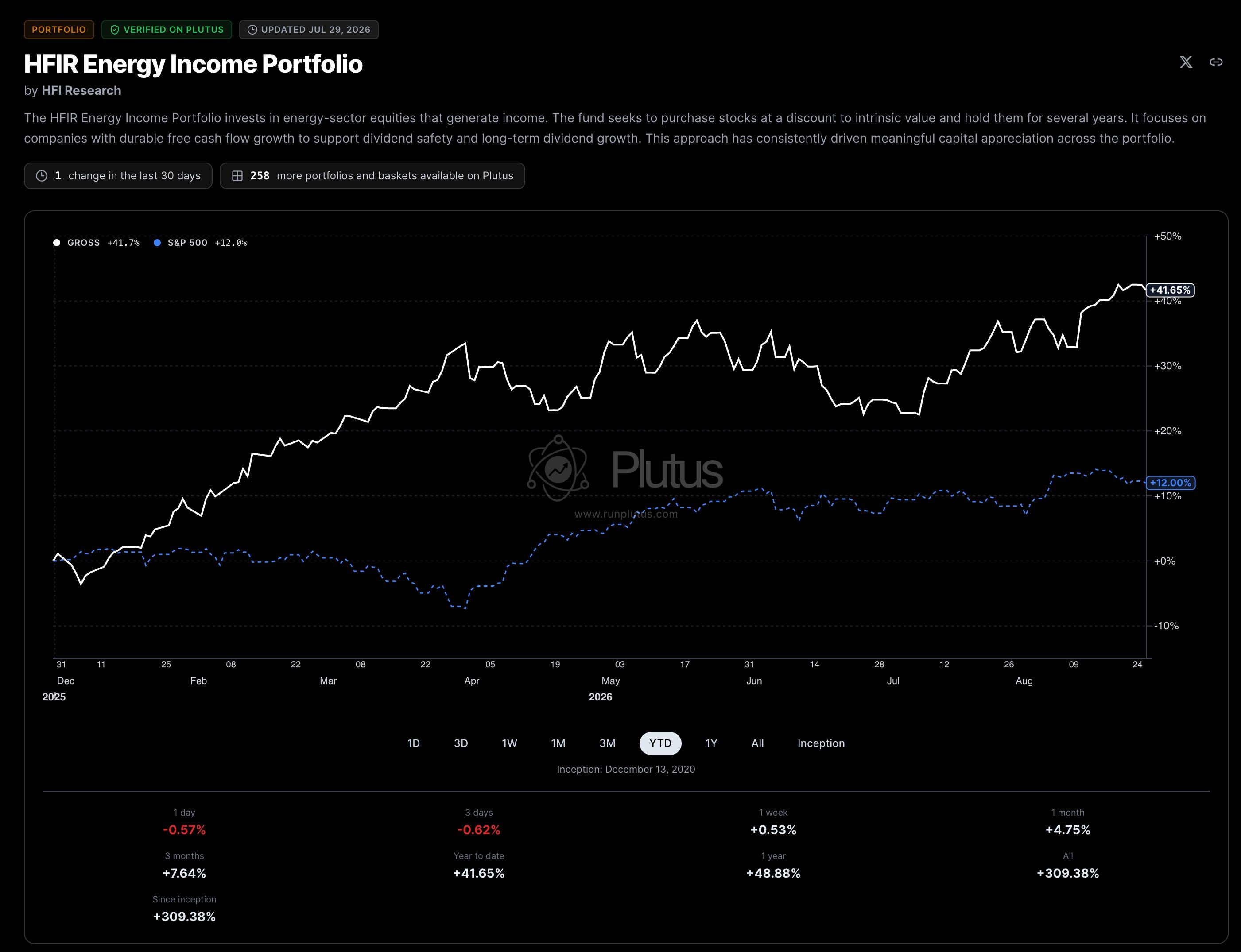
A defensive posture carries risks. The most obvious is that the bull market continues and substantial cash and fixed-income holdings lag rising stocks. I am willing to sit out part of a continuing advance. Fortunately, the high returns our portfolios have generated over the past few years afford us the luxury of time to wait for better buying conditions.
Cash can lose purchasing power, and longer-duration bonds can decline if interest rates rise. With these risks in mind, I prefer to hold short-term liquidity in the iShares 0-3 Month Treasury Bond ETF (SGOV).
There is also the danger that patience hardens into permanent caution. If prices fall and prospective returns improve, I will redeploy capital into the opportunities that emerge rather than invent reasons to remain defensive.
The job is not to remain fully invested. The job is to allocate capital intelligently. When bargains are abundant, that means buying with conviction. When they are scarce, it means protecting optionality and waiting. Today, waiting is not the absence of a strategy, it is the strategy.
Link to HFIR Energy Income Portfolio on RunPlutus.
Analyst’s Disclosure: I/we have a beneficial long position in the shares of the HFIR Energy Income Portfolio either through stock ownership, options, or other derivatives.