

Editor’s Note: We first covered VAL 9.48%↑ in a write-up back in March 2025. We have made it public to all readers.

By: Jon Costello
Earlier today, Transocean (RIG) announced it will acquire Valaris (VAL) in an all-stock deal valued at approximately $5.8 billion. Under the deal, Valaris shareholders will receive 15.235 Transocean shares for each Valaris share they owned as of February 6, before the announcement. This equals about $82.12 per Valaris share, reflecting a 31.6% premium over Valaris’s $62.41 pre-deal closing price.
Both stocks gained steadily throughout the day. Valaris closed at $83.82, and Transocean closed at $5.71, up 6.1% on the day.
Upon closing, Transocean will have an enterprise value of over $17 billion. Its shareholders will own 53% of the combined company, while Valaris shareholders will own the remaining 47%.
The deal marks a win for investors who purchased Valaris shares in the past eighteen months.
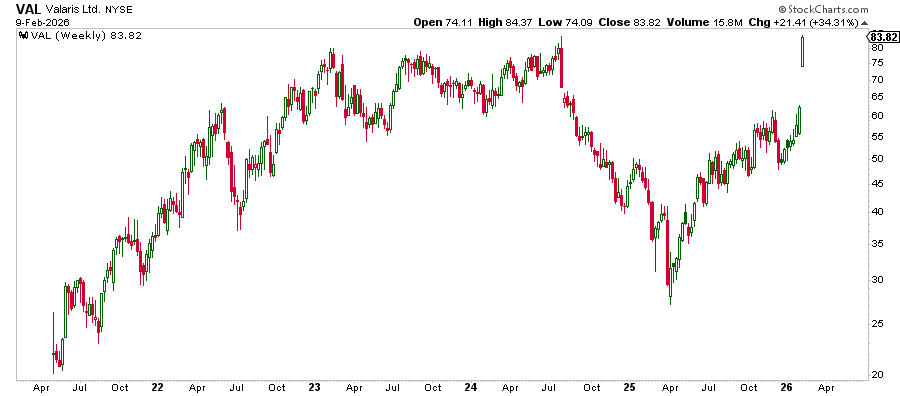
Since Transocean’s offer is for all stock, Valaris shares will swing around with Transocean’s share price until the deal closes. For investors seeking to maintain exposure to a recovering offshore market, it makes sense to hold onto the shares for the long term. I plan to hold all of my Valaris shares and exchange them for Transocean shares, which I expect to hold onto afterward.
The deal is also a win for Transocean shareholders in the near term, primarily because it supports the company’s efforts to delever its balance sheet. The additional operating cash flow from this deal reduces the combined entity’s interest burden relative to the legacy Transocean. Its shareholders will face less financial risk if dayrates were to turn down.
Management expects to realize $200 million in annual cost savings and aims for a leverage ratio of 1.5x Adjusted EBITDA 24 months after closing. The pro forma balance sheet based on the latest financial information shows $5.38 billion in net long-term debt, with $1.37 billion due within one year. Liquidity is strong, with $1.50 billion in pro-forma unrestricted cash and $859 million of pro-forma revolver availability, for total pro-forma of approximately $2.35 billion.
Once the deal closes, I expect management to begin considering reinitiating a dividend and/or share repurchases as the need to reduce debt diminishes.
The main negative for Transocean shareholders is the dilution from this deal. Transocean shareholders will own 51% of the combined entity on a fully diluted basis, resulting in nearly 100% dilution. Still, considering the reasonable price paid for Valaris—assuming the offshore market continues its recovery to new all-time highs—the enhanced earning power, improved market position, and lower risk effectuated by this deal make the dilution worthwhile.
This deal caught me by surprise, as I had agreed with the consensus view among many industry watchers that Valaris would be more likely to combine with Noble Corp. (NE) than with Transocean. Valaris and Noble have more similar fleets, which would yield greater relative competitive improvements and cost savings. However, as a shareholder of both Transocean and Valaris, I like this deal.
Late last year, I soured somewhat on Valaris’ management, particularly its weak capital-allocation performance. Share repurchases were a key part of my Valaris investment thesis, but the company failed to repurchase any shares during the first three quarters of the year, even though it had ample cash that was building over time, a conservative balance sheet, and shares trading at depressed levels. Repurchases made sense and would have been highly accretive. When no repurchases had been made, I was concerned that if management could botch capital allocation, it might botch other important areas of this business, which offers many opportunities for mistakes. I’m pleased that Transocean management will lead the combined entity.
Long-Term Benefits for Transocean
In the deepwater market, a contractor’s pricing power is determined by the availability of rigs, the quality of its fleet, and the suitability of its fleet for the work customers need. Firms in the industry compete based on who has available rigs of a particular spec in a particular basin at a particular time, and who can reliably deliver performance to large E&Ps in need of offshore drilling rigs.
The significant consolidation this deal represents for the deepwater market will reduce the options available to the industry’s E&P customers. Over the past nine years, mergers and acquisitions have narrowed the playing field of major deepwater contractors to three players: Transocean, Noble Corp., and Seadrill (SDRL). After this deal closes, these companies will operate an effective oligopoly. Consequently, they will see their pricing power rise over the longer term in the wake of this deal. In fact, the deepwater market will become so concentrated after this deal that a combination between Seadrill and Noble becomes even less probable because it will likely be blocked by regulators.
The deal benefits Transocean operationally by making it more of a one-stop shop for its large E&P customers. Upon closing, Transocean will own 73 rigs in total that run the gamut of deepwater, harsh-environment, and shallow-water basins.
The fleet of marketed ultra-deepwater drillships is well below 100, while the number of marketed drillships stands roughly 10% lower. Westwood puts the number of drillships at 80. It stated the following in its latest commentary on the market:

Source: Westwood Global Energy Data Dashboard, Jan. 26, 2026.
This deal will increase Transocean’s fleet of drillships from 20 to 33. Its ownership of more than one-third of the market will give it considerable pricing power.
Instead of a fleet composed exclusively of deepwater vessels, it will now include 33 jackup rigs. Jackup contracts tend to be shorter-cycle and can provide more stable utilization to complement Transocean’s deepwater fleet, which is longer-cycle and can entail lumpier contracting activity.
Transocean sold its jackup fleet in 2017. Transocean CEO Keelan Adamson stated on today’s conference call about the deal that the company does not plan to sell its jackup vessels, as the fleet provides incremental cash flow for the business.
Transocean will also have a more geographically diversified fleet. The addition of Valaris’ vessels will enhance its competitiveness in the Middle East, North Sea, and Latin America. This diversification will help stabilize cash flow throughout a cycle compared to a pure floater operator.
The deal will also boost Transocean’s position relative to smaller operators like Shelf Drilling (SHLLF) and Borr Drilling (BORR). Transocean can bundle services to customers in ways these smaller companies cannot.
Transocean’s strengthened balance sheet after the deal will improve its capital markets profile. The company will find it easier to negotiate with the specialized offshore debt market. The deal will also reduce Transocean’s cost of capital.
The company has been in liabilty-management mode for many years. This deal lessens the likelihood that debt negotiations involve another dilutive public equity offering and/or debt-for-equity exchanges like the recent one executed in late September. Additionally, the addition of Valaris shareholders will also broaden Transocean’s investor base, giving it greater staying power in its extremely capital-intensive business.
Impacts on Offshore Drilling Economics
For the market at large, the benefits are more structural and longer-term in nature. I don’t expect it to alter industry economics in the short-term. For instance, dayrates aren’t likely to move much in response to the deal.
For investors in the offshore drilling sector, the deal doesn’t change the fact that the bull case for these companies still hinges on the offshore drilling market being in a multi-year upcycle.
The deal will have significant ramifications for the industry over the longer term. The consolidation it represents shifts market power in favor of the incumbents.
As I’ve discussed in previous articles, the deepwater offshore market has massive barriers to entry. The global fleet has been winnowed down to levels where utilization rates remain healthy, even in subdued oil-market macro conditions such as today’s. The three remaining operators will be able to exert significant control over pricing as the cycle turns higher and demand for their vessels increases.
Consider that the price tag on a new vessel runs north of $1 billion, and construction takes years. Furthermore, the size, complexity, and demand of today’s deepwater projects mean that these vessels cannot be reconfigured from other vessels. The deepwater market will therefore benefit from multiple years in which competition from newbuilds is nonexistent.
The counterpoint to the industry’s oligopoly status is the concentrated nature of its customer base. Only a few national oil companies and supermajors have the scale to operate these vessels over the years needed to develop major deepwater projects. These large E&Ps can play the offshore contractors against each other to win concessions.
Still, a tight deepwater market—characterized by high vessel demand amid limited supply—will ensure premium pricing for the remaining players. Capex budgets will increasingly prioritize offshore development projects over onshore. E&Ps seeking to bolster production, extend reserve lives, and explore and develop assets as efficiently as possible will be forced to bid against one another to secure the remaining vessels in this oligopolized industry.
The remaining deepwater contractors can become price setters in a tight market. They will be able to extract more favorable dayrates for longer durations and win other concessions such as customer-funded vessel upgrades. They will also have greater bargaining power over shipyards, which have dwindled in number over recent years. Their bargaining power with vendors and equipment providers will increase, enabling more efficient funding of the technology upgrades often demanded by deepwater vessel customers.
Risks
The press release announcing the deal mentions change-of-control risk. Some of Transocean’s customers may amend or terminate their existing contracts after the deal closes.
Other risks are the same in any deal like this. For example, integration risk and regulatory and approval risk.
Conclusion
This deal is positive for Transocean shareholders and Valaris shareholders, as well as for the offshore market outlook. It is likely to add support to offshore drilling stock prices. For Transocean, it largely eliminates existential risk amid a downdraft in dayrates that previously sent the shares plunging below $3.00. These stocks have been on fire recently, so I’m not interested in buying until a pullback. But for investors who already own the names, I believe they’ll do well if they hold on for the next few years.
Analyst’s Disclosure: Jon Costello has a beneficial long position in the shares of RIG, VAL, NE either through stock ownership, options, or other derivatives.