

Occidental Petroleum’s (OXY) stock has recently sold off into the mid-$50s, significantly below the low-$60s range where Warren Buffett bought them for Berkshire Hathaway. The selloff has caused OXY shares to become the most attractive alternative among large-cap U.S. E&Ps. Every energy investor should take a look at what’s on offer at today’s price. Over the next few years, we expect them to rise well above the low-to-mid $60s trading range they’ve maintained since 2022.
OXY Overview
OXY is a U.S.-domiciled oil and gas E&P with operations in the U.S. and Middle East. It produces approximately 1.3 million boe/d, split 75%/25% between liquids and natural gas.
The company’s global operating footprint is shown below.

Source: OXY Q2 2024 Earnings Conference Call Presentation, Aug. 8, 2024.
Geographically, OXY’s production is split 82%/18% between the U.S. and the Middle East. Its operations are spread throughout the DJ Basin in Colorado, the Powder River Basin in Wyoming, and the Permian Basin in West Texas and New Mexico. Its production mix by operating region is shown below.

OXY’s largest U.S. operation is in the Permian basin, where it produces roughly 725,000 boe/d, representing 59% of companywide production.
OXY’s non-E&P operations consist of its low-carbon ventures and its OxyChem petrochemical manufacturing segment.
The company’s low-carbon venture explores ways to help customers reduce their carbon footprint. The operation is housed in OXY’s midstream segment, and management doesn’t break out its financials. One of OXY’s first low-carbon projects was a direct air capture joint venture with BlackRock (BLK). Despite its recent progress, we suspect the low carbon ventures have yet to turn a profit.
OxyChem is OXY’s petrochemical manufacturing operation. It accounted for 23.7 of OXY’s revenues in the first half of 2024.
In recent years, OXY has undergone an asset “high-grading” program in which it shed lower-returning E&P assets and expanded its roster of high-return opportunities. Most of its high-grading efforts have aimed at increasing production in the Permian Basin.
OXY’s most significant step in that direction was its acquisition of Anadarko Petroleum in 2019. The acquisition featured a bidding war with Chevron (CVX), as well as vocal opposition and a lawsuit against OXY from Carl Icahn.
The deal’s $38 billion price tag strained OXY’s balance sheet. It required OXY to issue $13 billion of new debt and $15 billion of new common shares and pursue a financing deal whereby it sold $10 billion of convertible preferred stock to Berkshire Hathaway (BRK.B). The Berkshire preferreds pay an 8% dividend and include 80 million warrants to purchase OXY common stock at an initial exercise price of $62.50 per share. The Berkshire warrants remain exercisable as long as the preferreds remain outstanding. OXY raised additional captial to fund the Anadarko deal through the formation of a $1.5 billion drilling partnership with Ecopetrol (EC) to develop part of its Permian acreage.
OXY’s latest move to expand in the Permian was its $12 billion acquisition of privately-held CrownRock, which closed on August 1, 2024. The deal involved the issuance of $9.1 billion of debt, $1.2 billion of common stock, and the assumption of $1.2 billion of CrownRock debt.
CrownRock’s assets were located in the Midland basin, substantially contiguous with OXY’s acreage. The map below shows OXY’s Permian acreage in blue and CrownRock’s acreage in red.

Source: Oil & Gas Journal, Dec. 11, 2023.
The CrownRock acquisition increased OXY’s inventory of high-quality drilling prospects, increased the company’s scale in the Midland sub-basin of the Permian, and improved operational efficiencies attributable to infrastructure sharing, resource utilization, and lower costs.
The addition of CrownRock assets caused OXY to increase its full-year 2024 production guidance from 1.25 million boe/d to 1.32 million boe/d. The acquisition was immediately accretive to OXY’s cash flow and allowed it to boost its quarterly dividend by $0.04 per share to $0.22 per share.
As it acquired Permian assets, OXY has simultaneously divested Permian acreage it considers non-core to its operation. Proceeds from the divestitures helped reduce leverage and fund additional core acreage acquisitions.
OXY’s 2020 Warrants
On August 3, 2020, OXY issued 116 million common stock warrants at a rate of 0.125 warrants for each share of OXY owned. The warrants have an exercise price of $22.00 and expire on August 3, 2027. They trade under the ticker “OXY.WS.” The company said it distributed the warrants “to provide value to our existing shareholders.”
Investors can purchase the warrants on the open market. They represent a leveraged wager on OXY shares as long as the shares trade above the warrants’ $22.00 exercise price. Over the next few years, the exercise of the warrants will generate substantial cash flow for OXY.
Capital Allocation Favors Debt Reduction
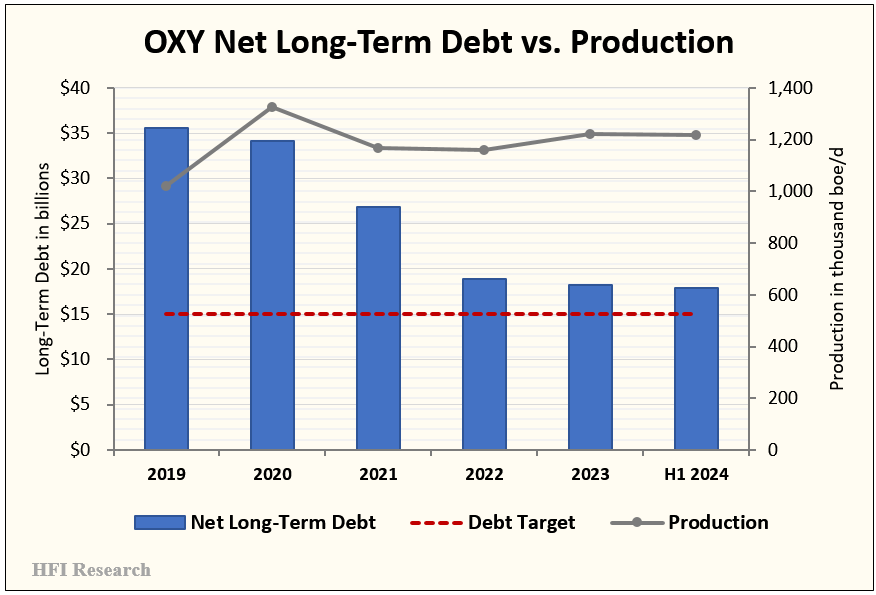
In the wake of the CrownRock deal, OXY remains focused on reducing long-term debt to management’s target of $15 billion. At the end of the second quarter, long-term debt stood at $19.7 billion.
In December 2023, in connection with its CrownRock acquisition, OXY announced a divestiture program aimed at raising $4.5 billion in 12 months and up to $6.0 billion over the 18 months following the announcement. As of August, it had raised $3.0 billion through divestitures, well on its way to meeting its $4.5 billion goal.
OXY’s captial allocation has been impressive in the company’s record of paying down debt through free cash flow and asset divestitures while maintaining flat production, as shown below.
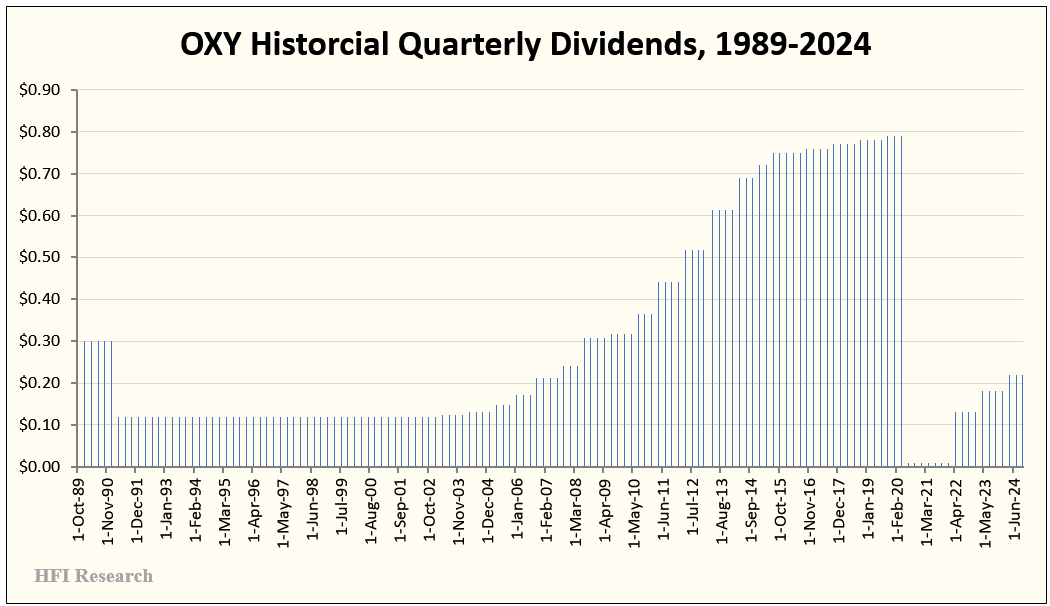
Management has indicated that after deleveraging, it remains focused on paying dividends. After slashing its dividend to one penny during the 2020 downturn, it has consistently increased its dividend to $0.22. On its $54.75 share price, the dividend yields 1.6%.
OXY’s dividend payments have facilitated preferred stock redemption, one of the most potent capital allocation alternatives available to management in terms of increasing long-term intrinsic value for common shareholders. The terms of the Berkshire preferred stock state that after OXY has paid $4.00 of dividends on a cumulative basis since the deal was struck in 2019, it could redeem a portion of the Berkshire preferreds at a 10% premium. OXY cannot voluntarily redeem them before August 2029, at which point it can redeem them at a 5% premium.
Having passed the $4.00 hurdle in 2023, OXY redeemed $1.5 billion of the preferreds, which reduced its dilutive share count by eliminating unexercised Berkshire warrants. A total of $8.5 billion of the preferreds remain outstanding.
Share repurchases are the last priority until OXY reaches its $15 billion debt target. In 2023, OXY repurchased 29.1 million shares for $1.8 billion at an average cost per share of $61.16. This year, however, repurchases have been immaterial, amounting to only $9 million.
OXY has other means of raising capital at its disposal. It owns 166.2 million common units of the midstream master limited partnership Western Midstream Partners (WES), representing a 43.7% equity interest. OXY inherited its WES stake from its Anadarko acquisition.
In August, OXY sold 19 million WES units in a secondary offering for proceeds of $686 million. OXY put the proceeds from the sale toward reducing debt.
OXY’s remaining WES stake is worth approximately $6.5 billion. Media reports have speculated that OXY is interested in selling its entire WES stake. Such a sale would generate significant proceeds for debt reduction, but it would also reduce OXY’s cash flow. WES’s $3.50 annual base distribution generates $648 million of cash flow for OXY.
WES has attractive long-term prospects, with growth derived from serving new third-party customers in the Permian and DJ basins. We would view an outright sale as not in the best long-term interests of OXY shareholders. After all, OXY is not desperate to deleverage. Given its substantial free cash flow generation and asset divestitures program, even at current oil prices, it will organically de-lever to its $15 billion long-term debt target over the next year. OXY will also receive cash as its 2020 warrants are exercised. In the first half of 2024, $487 million of inflows occurred from warrant exercises. As of June 30, 2024, 77.3 million warrants were outstanding.
Moreover, control of WES allows OXY to optimize its infrastructure development. A sale could complicate its E&P logistics while also increasing transportation costs and lowering OXY’s netback.
That being said, there may come a time for OXY to divest of its WES stake. One would be if OXY finds itself in a position where it can redeem the Berkshire preferreds. A sale of the WES stake could make sense, depending on stock prices and company outlooks at the time.
Growth Initiatives
OXY has grown its oil production through acquisitions and the ongoing high-grading of its asset portfolio. We expect a low-single-digit rate of production growth over the next five years.
It also plans to grow its low-carbon ventures through carbon capture and sequestration initiatives, among others. Its 1PointFive business, a wholly-owned OXY subsidiary, recently struck a deal with Microsoft (MSFT) to sell it 500,000 metric tons of carbon dioxide removal credits over six years. The credits will help Microsoft reach its goal of becoming carbon-negative by 2030. The deal requires OXY to capture carbon dioxide and store it through “subsurface saline sequestration,” a means of direct air capture of carbon dioxide.
We assume this and other such deals will be profitable for OXY. However, because they’re untested and have somewhat uncertain prospects due to their heavy dependence on government support, we assign zero value to them in our valuation of OXY shares.
OXY is currently growing its OxyChem business. This is a valuable low-cost operation that sports an EBITDA margin of 25% and a return on capital in the 15%-to-20% range. Historically, OxyChem’s returns have improved with higher commodity prices. This may seem counter-intuitive, as the prices the company pays for its petrochemical feedstock are dependent on market prices for petroleum products. Higher oil and gas prices bring higher petrochemical feedstock prices, so petrochemical margins and cash flows are often squeezed as input costs rise. Fortunately for OxyChem, rising commodity prices present a tailwind for its sales because many of its customers are oil-and-gas market participants that see their own cash flow grow with higher commodity prices. As a result, OxyChem’s business is considerably more stable and less cyclical than other large petrochemical operations.
OxyChem is currently converting one of its manufacturing plants to a new product, which has temporarily increased capex. OxyChem consumed $535 million of capex in 2023 and approximately $700 million in 2024. The plant conversion is expected to be complete in 2026. We expect the investment to add $100 million to OxyChem’s margin contribution. Moreover, assuming the segment doesn’t have additional large projects on the drawing board, OXY’s capex will fall in 2026. The increased cash flow and lower capex will boost OXY’s free cash flow.
Risks
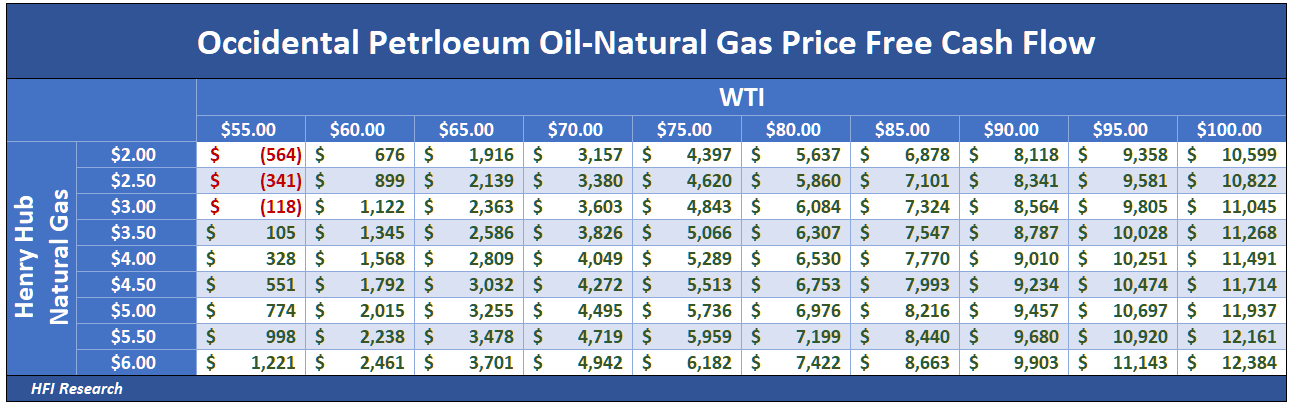
OXY’s greatest overall risk stems from a sustained bout of low commodity prices. We estimate its free cash flow breaks even at $58 per barrel WTI, assuming $2.00 per mcf Henry Hub natural gas. If oil traded well below that level for some time, OXY will have to reduce capex or else remain at risk of increasing its long-term debt balance. Lower capex would result in lower production and cash flow generation.
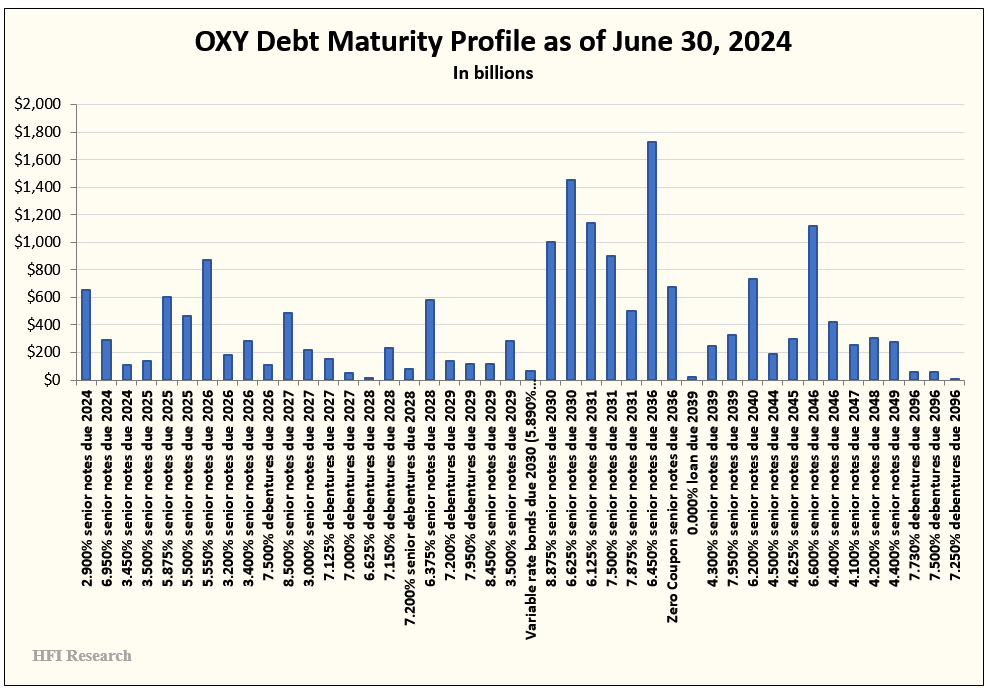
OXY’s debt maturities don’t pose a meaningful risk. The company’s maturities are spread over many years, as shown below.
OXY’s greatest operational risk is its need to replenish its reserves. The company’s combined proved/developed and proved/undeveloped reserves span 8.9 years. This isn’t a cause for concern at the moment, as OXY has successfully replaced its reserves for many years. In 2023, its reserve replacement rate was 137% despite significantly lower commodity prices versus 2022. Its 2023 reserve replacement was driven by discoveries of and extensions to reserves in its U.S. shale acreage. That being said, if OXY fails to replace its produced reserves, investors could grow skittish about its long-term value and send its shares lower. They may also become concerned that another risky transformative acquisition could be imminent.
Another potentially significant operational risk is the increasing gas content of U.S. shale oil production. OXY’s production has exhibited some signs of this, as is evident in the following chart.
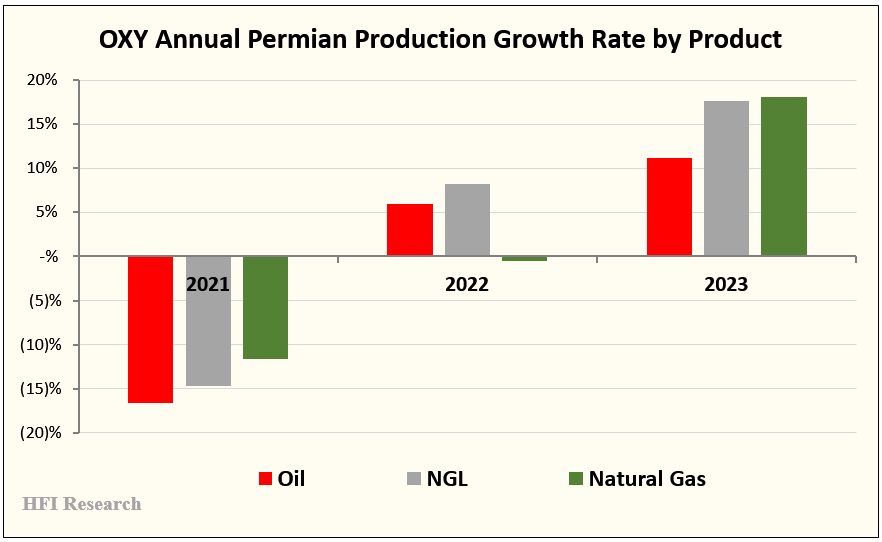
Notice that when OXY’s Permian production fell in 2021, its crude production declined at a greater rate than natural gas and NGLs. Then in 2022 and 2023, OXY’s Permian natural gas and NGL production grew at a greater rate than its crude oil production.
Acreage divestitures potentially skew these data, and OXY’s 2022 natural gas production result was lowered by anomalously weak first-half production. Our intention is simply to highlight an increasing gas-to-oil ratio in OXY’s Permian and other shale acreage as a potential risk to monitor. Greater production of low-value natural gas and NGLs versus crude will reduce free cash flow, all else equal.
Outside of the E&P business, OXY is at risk from OXY’s OxyChem petrochemical operation, which may be subject to large, unexpected environmental litigation and fines in the future.
Valuation
While the oil majors, Exxon Mobil (XOM), Chevron (CVX), and ConocoPhillips (COP) stocks respectively trade at an 8.7, 7.6, and 6.2 times multiple to estimated full-year 2024 cash flow, OXY trades at a comparatively low 4.4 times.
OXY’s lower multiple is due to its heavier concentration in the E&P business, which introduces various risks without the mitigation provided by diversification. OXY’s cash flow results are more cyclical and variable than its larger oil major peers.
That said, we expect OXY to generate returns on capital employed that are competitive with the oil majors over the course of an entire oil market cycle. We also regard the perceived risk that management will pursue another major acquisition as low. So while we understand the higher volatility of OXY shares, we would expect the average multiple at which they trade to be well in excess of the 4.4 times cash flow at which they trade today.
OXY also sells at a discount to high-quality, large-cap, pure-play U.S. E&Ps. Before its acquisition by XOM, Pioneer Natural Resources traded at a premium to OXY. Today, Diamondback Energy (FANG) trades at 5.3 times cash flow.
By contrast, OXY’s valuation is on par with the Canadian oil sands E&Ps. For instance, CVE trades at 4.4 times, and SU is at 4.8 times 2024 cash flow.
OXY’s relative valuation discount presents an opportunity to buy its stock as its multiple improves relative to peers. Consider that if its shares traded at a more reasonable 5.0 times cash flow, they would trade nearly 10% higher than their current price.
Meanwhile, OXY possesses significant cash flow torque to commodity prices. Our estimates of its free cash flow generation at different commodity prices are shown below. The estimates assume a $800 million annual free cash flow contribution from OxyChem.
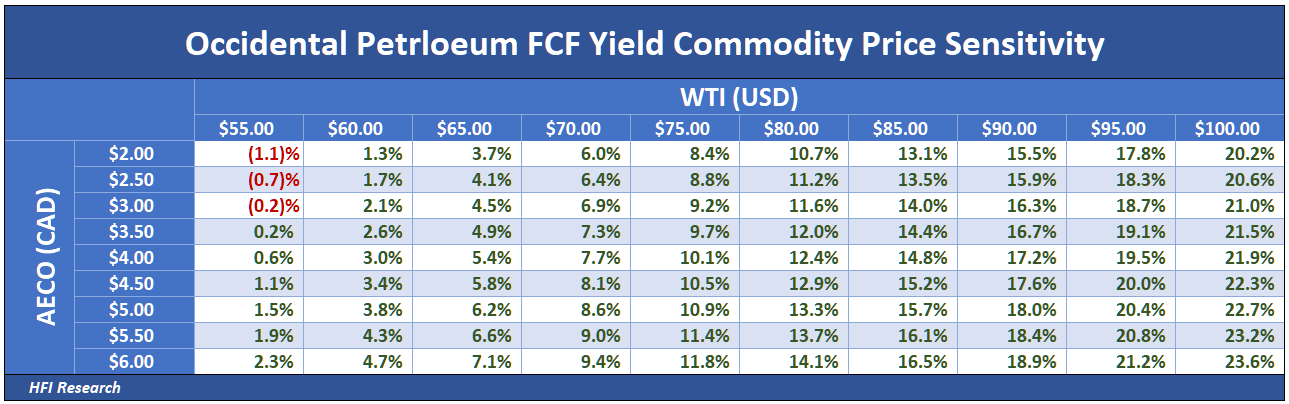
Our estimate of OXY’s free cash flow yield at different commodity prices is shown below.
Assuming the shares trade at a 12% free cash flow yield, the next table shows the price at which we estimate the shares would trade.
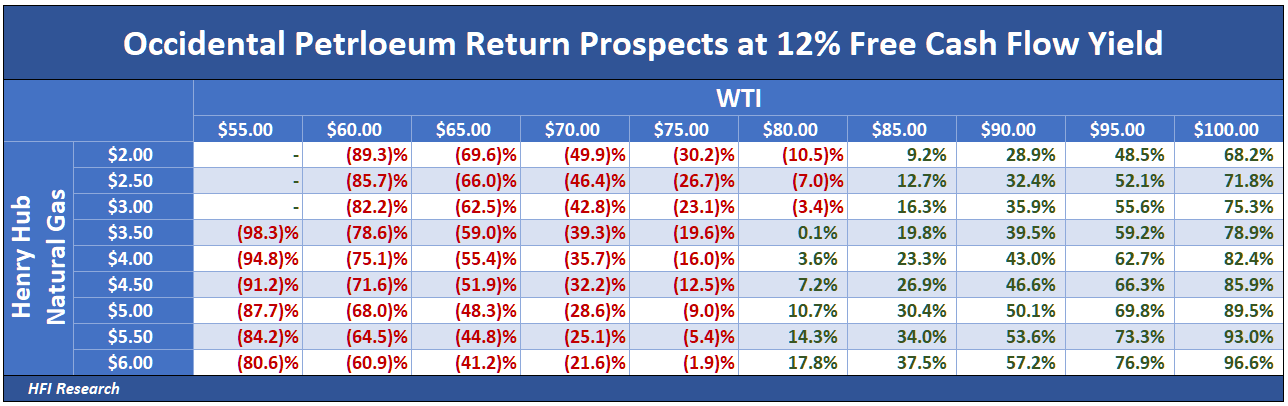
The final chart shows our estimated return prospects for OXY shares at different commodity prices, assuming the shares trade at a 12% free cash flow yield. We estimate the shares currently discount roughly $80 per barrel WTI, assuming a Henry Hub natural gas price of $2.80 per mcf.
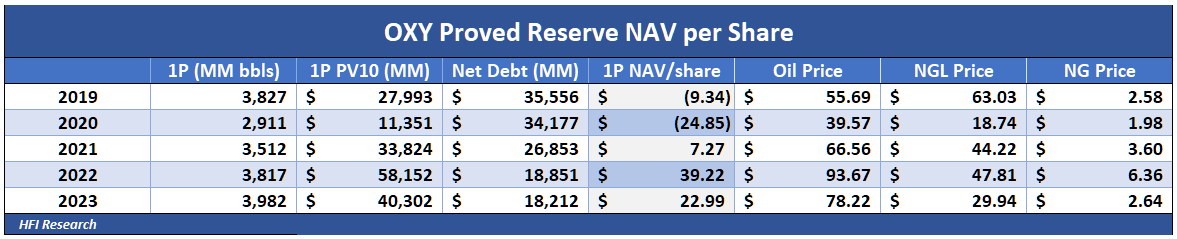
OXY shares trade at a steep premium to the company’s proved reserve net asset value per share, which stands at $22 per share. Of course, this valuation fails to account for OXY’s CrownRock acquisition and its OXYChem petrochemical operation. It also fails to account for the discoveries and extensions likely to occur over the coming years.
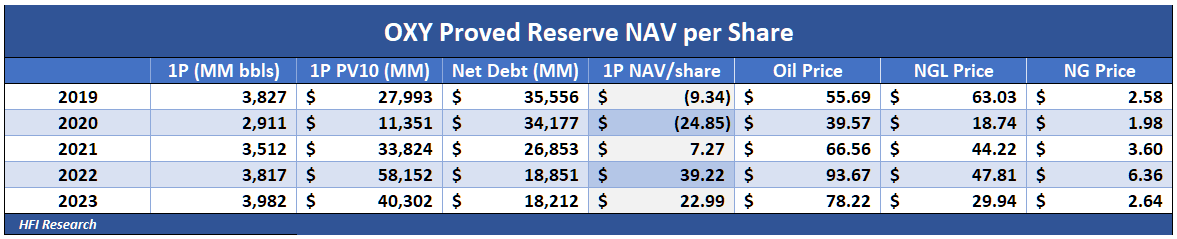
OXY’s 2023 reserve estimate uses lower commodity prices than we expect to prevail through the end of the decade. We therefore don’t consider it as the most important metric for evaluating OXY’s intrinsic value per share. As the company pays down debt, its reserve net asset value per share will increase. Assuming debt of $15 billion, 2023 net reserve value per share would be $26.33, 14.5% above today’s value.
Our discounted cash flow valuation uses a 10% discount rate and assumes $1 billion of margin contribution from OxyChem, zero contribution from low-carbon ventures, a static share count, and constant free cash flow at $85.00 per barrel WTI and $3.00 per mcf natural gas. It also assumes OXY’s terminal value remains intact. The valuation estimates that OXY is worth $79.99 per share, implying 46% upside from the current price of $54.75.
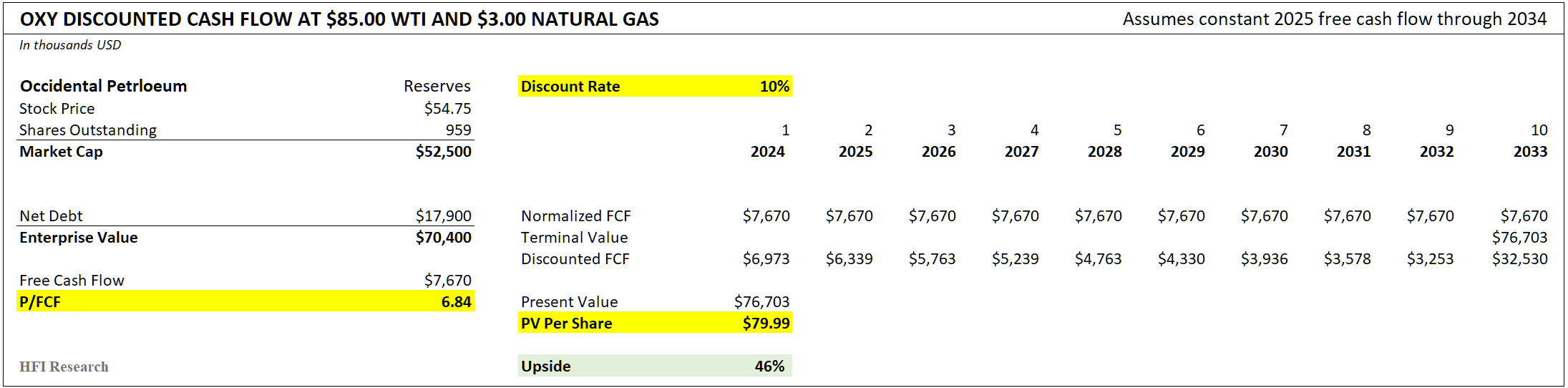
We believe that over time, OXY’s share price will migrate toward our $80 per share estimate if the company can grow its production at the low-single-digit annual rate we expect while also reducing leverage. We expect the shares to do particularly well from their current price if oil and natural gas prices increase to the higher average levels we expect over the next five years.
Conclusion
We believe buying OXY shares—or, for risk-seeing accounts, its 2020 warrants—while investor sentiment toward oil and E&Ps is in the dumps is the most prudent course. That’s certainly the case today.
OXY’s low downside risk makes it an effective way to play the $70 to $90 per barrel range in which WTI has traded over the past few years. We’re closer to the bottom of the range now, making it a good time to buy OXY shares. We’d expect the shares to rise into the high $60s if WTI heads into the high-$80s.
Longer-term, as the company demonstrates its cash flow generation potential, we expect the shares to rise toward our $80 per share discounted cash flow valuation if oil prices are sustained in the $80s per barrel and above, as we expect.
OXY shares present some of the best risk/reward propositions among large-cap E&Ps. Its shares should be bought and held for their significant appreciation potential over the next few years.
Analyst's Disclosure: I/we have a beneficial long position in the shares of SU either through stock ownership, options, or other derivatives.