

By: Jon Costello
Occidental Petroleum (OXY) shares have underperformed their large-cap peers over recent months. Despite the underperformance, OXY’s fundamental results have been strong, and its near-term and longer-term outlook for shareholders remains positive. Investors may want to consider buying the shares either as a catch-up trade based on a summertime oil price rally or as a long-term investment that will benefit from growth in shareholder value over the coming years.
OXY Has Lagged Its Peers
It wasn’t long ago when OXY shares exhibited relative strength as Berkshire Hathaway (BRK.B) amassed its 27% equity stake. Those days are long gone. OXY shares have sold off year to date and are now approximately 20% below Berkshire’s average cost for its stake in the mid-$50s per share.
For multiple consecutive quarters, OXY shares have badly lagged behind their peers—both independent U.S. shale E&Ps and international oil & gas majors. The following chart plots the performance of OXY’s stock versus its large-cap U.S. peers over the past year.
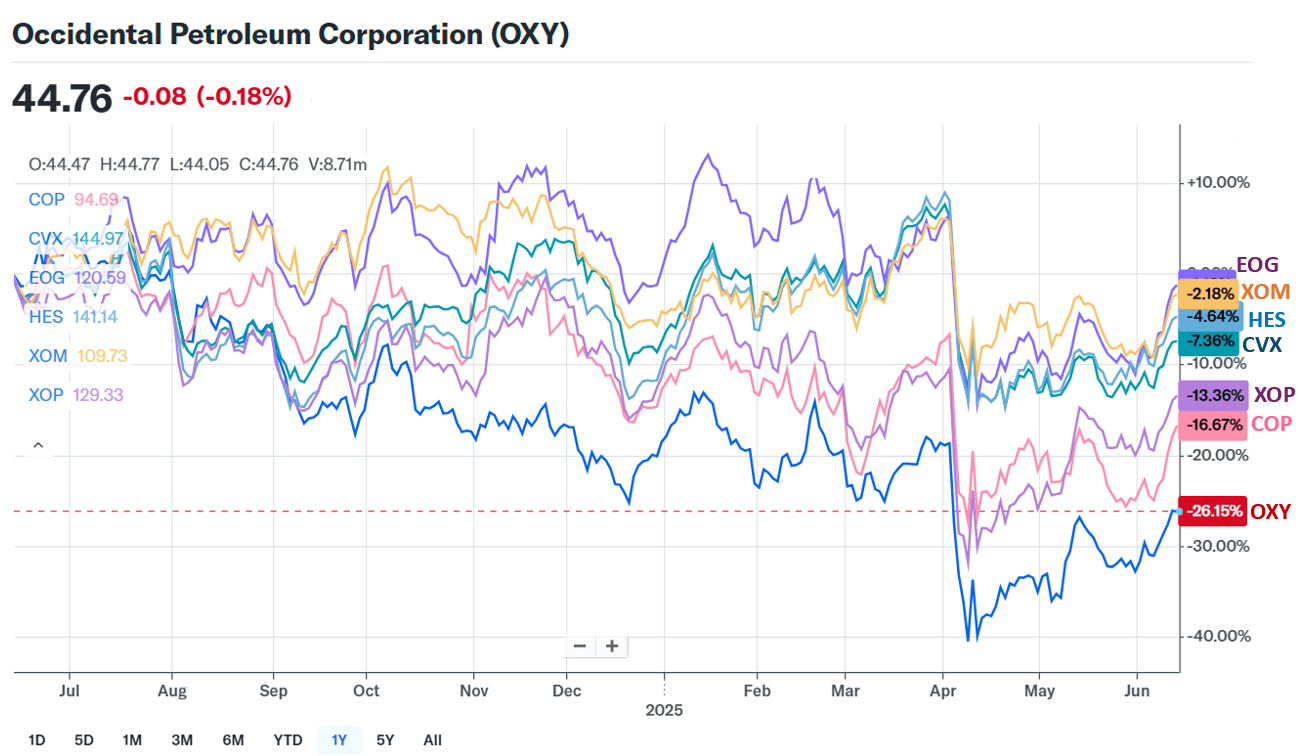
Source: Yahoo! Finance, June 12, 2025.
While OXY shares may have received too much support from Berkshire’s backing, the recent underperformance is overdone. Even the company’s critics, who take issue with the caliber of its management, the purchase price of large shale acquisitions, or the ultimate value of its foray into carbon capture, have to acknowledge that nothing is fundamentally wrong with the company.
The most valid criticism of OXY is that its leverage is high—at approximately two-times operating cash flow at $70 per barrel WTI—but leverage must be considered relative to free cash flow generation, and OXY becomes a free cash flow machine as oil prices rise above $70 per barrel. OXY’s balance sheet shows no signs of strain. It will easily meet its debt maturities as they come due. As it pays down debt, grows its non-oil and natural gas-related operations, and benefits from higher commodity prices, value will accrue to shareholders from their increased claim on the company’s equity and higher free cash flow per share.
I expect management’s continued execution to drive future outperformance in OXY shares. The shares appear attractive as either a relatively short-term catch-up trade amid a summer oil price rally or over a multi-year holding period as OXY pays down debt and executes other accretive capital allocation measures for shareholders.
Operating Performance is Strong
OXY’s operating results have been consistently solid, both on a quarterly basis and over a stretch of recent years.
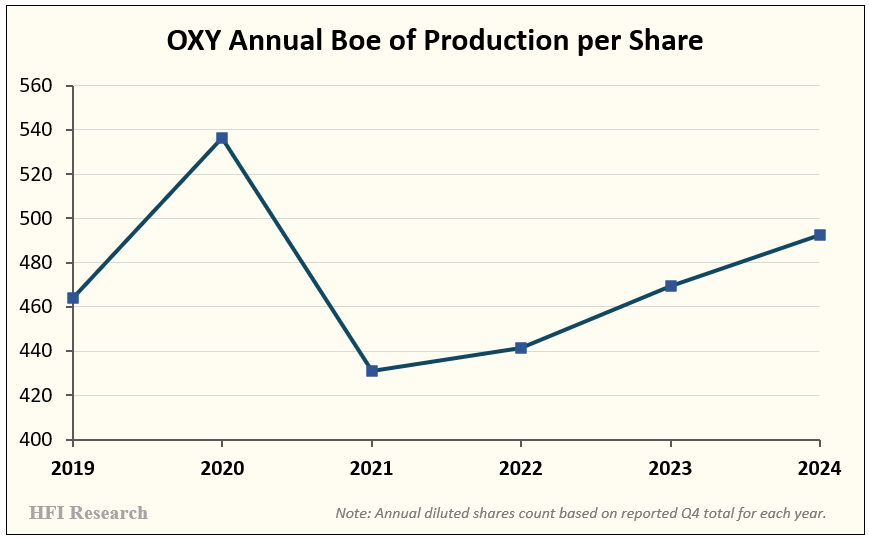
Production growth per share has steadily increased each year after the large noncore asset sales made during the 2020-2021 timeframe, which were aimed at reducing long-term debt used to fund the Anadarko Petroleum acquisition. Share repurchases were also a significant factor in increasing the metric.
OXY boasts industry-leading capital efficiency driven by large, contiguous acreage holdings in the core of the Permian basin and low-cost conventional production in the Gulf of America and internationally.
Excluding acquisitions, OXY’s capital efficiency in 2024 was $18,773, one of the lowest among major E&Ps. Using OXY’s full-year 2025 guidance, leaving out its $1.2 billion divestiture of noncore acreage in the Rockies and the Permian in the first quarter, and assuming no acquisitions or dispositions, its capital efficiency in 2025 will be a very attractive $17,700.
The consistent improvement in OXY’s capital efficiency over recent years can be seen in the chart below.
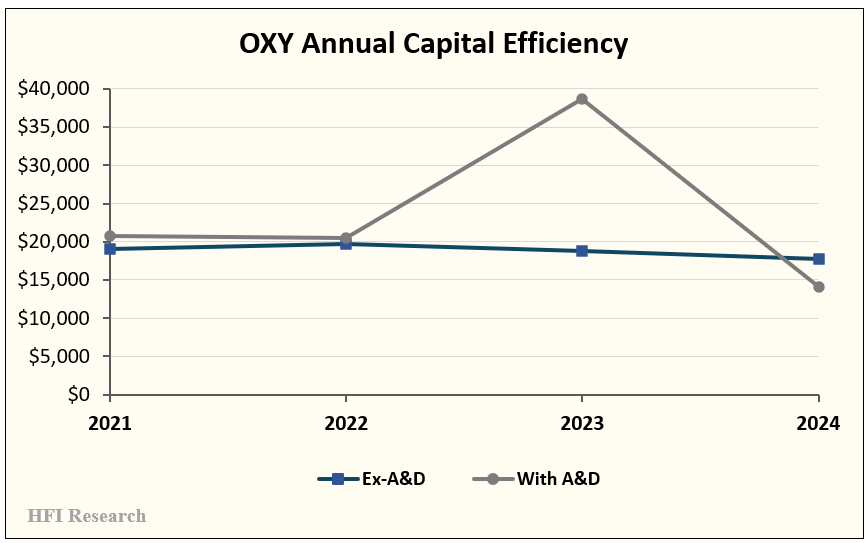
This impressive performance suggests that management’s claims regarding drilling efficiency improvements are translating to financial results.
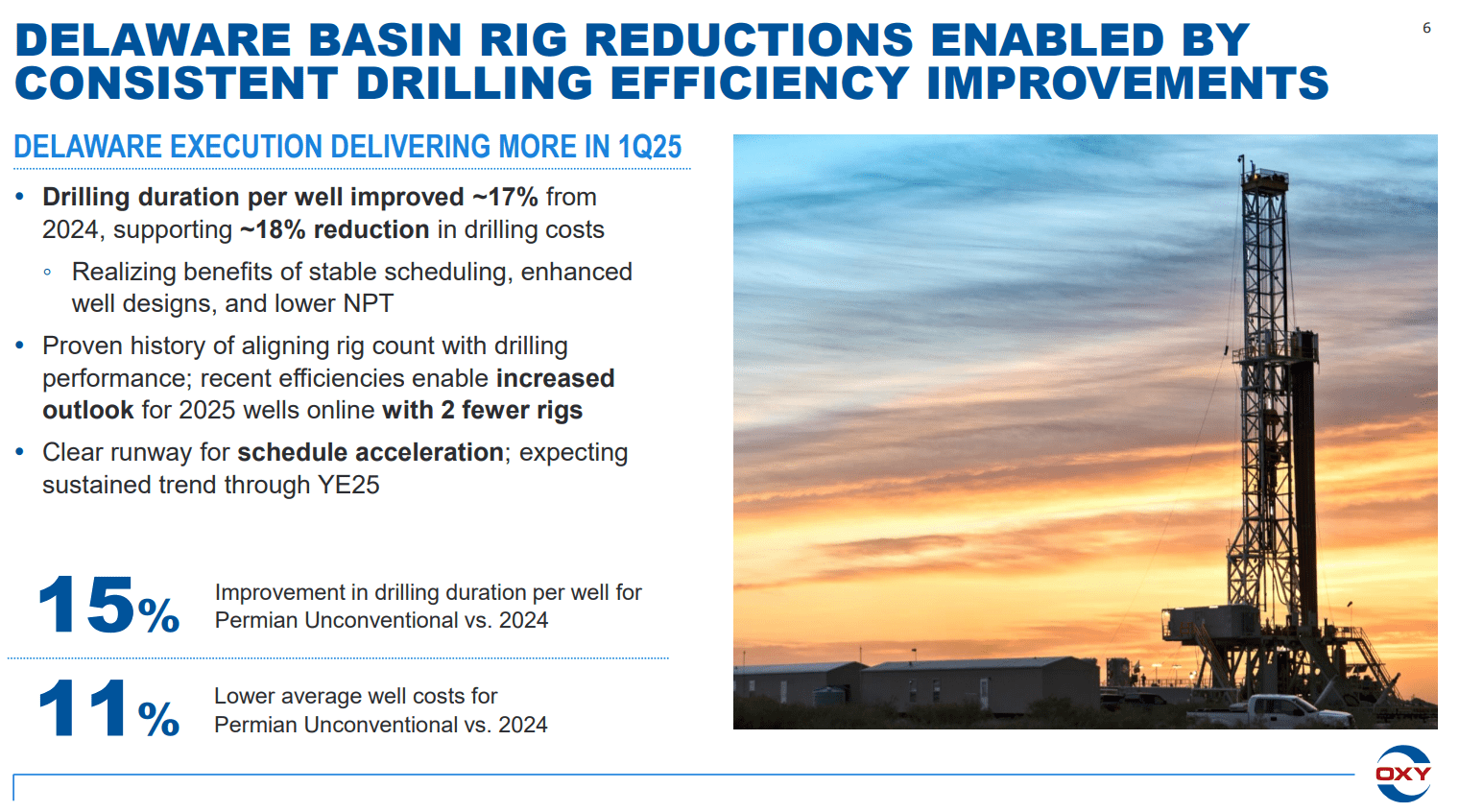
Source: Occidental Petroleum Q1 2025 Earnings Slide Presentation, May 8, 2025.
The upshot of improving capital efficiency for shareholders is that production can be sustained with less capex. The resulting free cash flow can then be allocated to dividends, share repurchases, or acquisitions.
Capital Allocation Has Been Excellent
With major consolidation in the U.S. shale oil patch in the rearview mirror—making a large domestic acquisition for OXY unlikely—capital allocation is the most important value-creation factor for OXY shareholders going forward.
On this front, the company’s performance has been superb. If its performance continues, OXY shareholders are likely to benefit from the company's growing free cash flow generation capacity and increasing equity value per share.
OXY remains committed to further reducing debt before it pivots in favor of dividends and share repurchases. The company has successfully reduced net long-term debt from $35 billion in 2019 to $22.5 billion at the end of the first quarter. Management’s long-term debt target is $15.0 billion, which it expects to achieve in the 2026-2027 timeframe. Long-term debt ticked higher in 2024 due to debt incurred in OXY’s CrownRock acquisition.
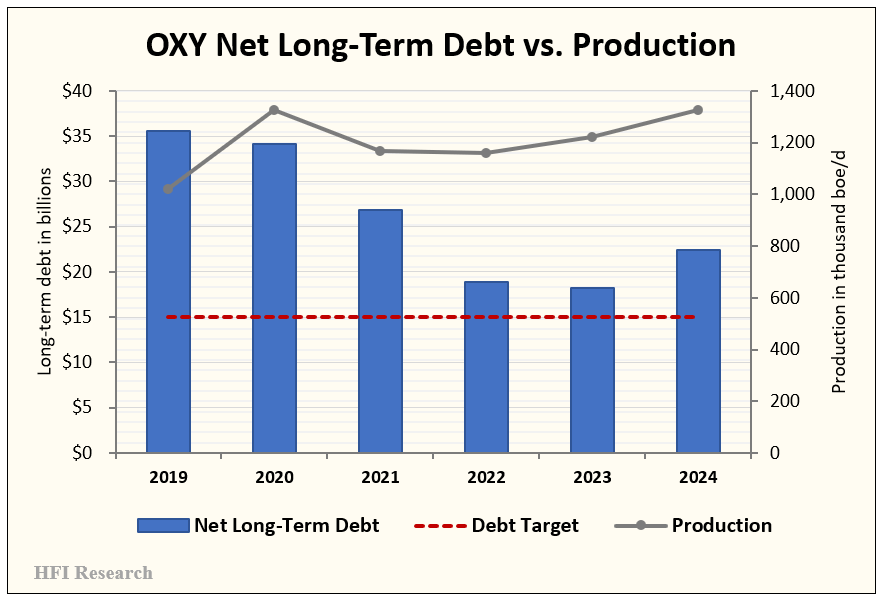
After the close of the CrownRock acquisition on August 1, 2024, OXY’s debt reduction has been impressive. OXY paid down $6.8 billion in debt, exceeding its near-term debt reduction target by more than 50%, as shown in the chart below.
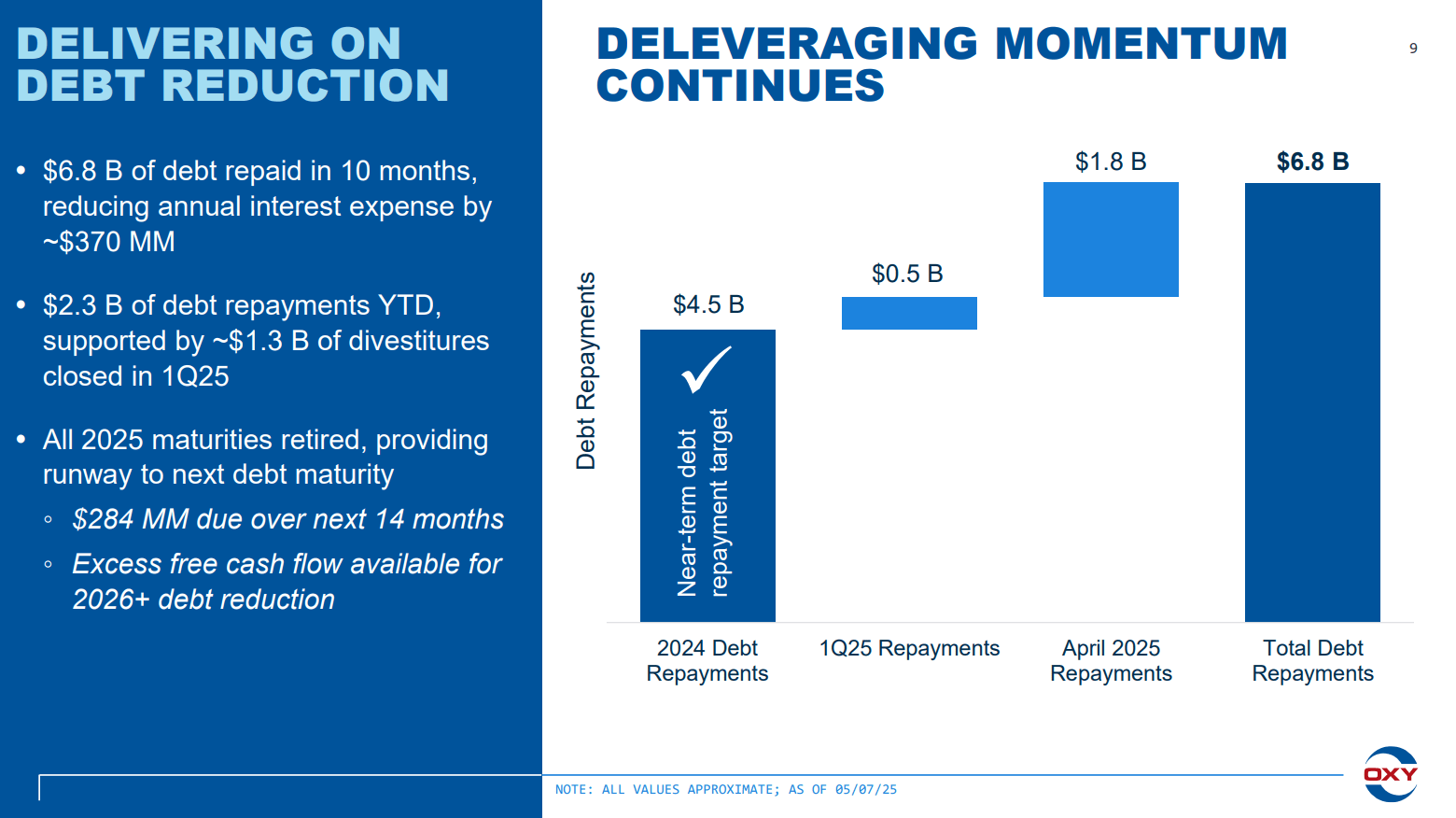
Source: Occidental Petroleum Q1 2025 Earnings Slide Presentation, May 8, 2025.
Once the company achieves its net debt target by allocating free cash flow and asset divestiture proceeds to debt reduction, its shareholders can expect dividend increases and significant share repurchases.
The rate of OXY’s debt reduction will depend on the course of oil prices, which dictate the amount of free cash flow it can generate. Barring significant asset dispositions, I believe the company is likely to reach its net debt target in 2027 unless oil prices are sustained at $80 per barrel or higher for several quarters.
OXY’s cash flow generation prospects imply that debt will remain the company’s top capital allocation priority for several years. Free cash flow at lower oil prices will prevent a more rapid debt paydown. I estimate that free cash flow in 2025 would be approximately $5.54 billion at $70 per barrel WTI and $3.00 per mcf Henry Hub natural gas prices, assuming that OXY’s OxyChem industrial chemicals segment generates $1 billion, that distributions from OXY’s 46% economic stake in Western Midstream Partners, LP (WES) equity generate $630 million, and using management’s 2025 production and capex guidance. 2025 free cash flow. After $950 million in dividends and $1.4 billion of share repurchases—in line with the 2024 total—OXY would have $3.2 billion to allocate toward debt reduction. Under this scenario, the company would reach its debt target in late 2027 at an average WTI price of $70 per barrel, and assuming no asset dispositions are made over the next few years.
In any event, I expect significantly higher dividends and share repurchases from OXY in 2028 and beyond. Dividend increases could occur sooner. Higher oil prices and/or accretive asset dispositions will accelerate debt reduction versus the above estimates. The company has already increased its dividend, even though its net debt target remains far off. Most recently, it hiked its dividend by 9% in 2024.
OXY’s 564% dividend coverage by free cash flow at $70 per barrel WTI and $3.00 per mcf natural gas points to the potential for increased shareholder distributions.
Valuation
OXY’s intrinsic value is likely to remain constant as long as the company can replace its reserves and maintain its capital efficiency at low levels. Intrinsic value is likely to receive a material boost beginning in 2027, as non-oil & gas-related operations undergo a cash flow inflection that will increase free cash flow by an incremental $1.5 billion over expected 2025 levels.
The chart below depicts the improvement that lies ahead.
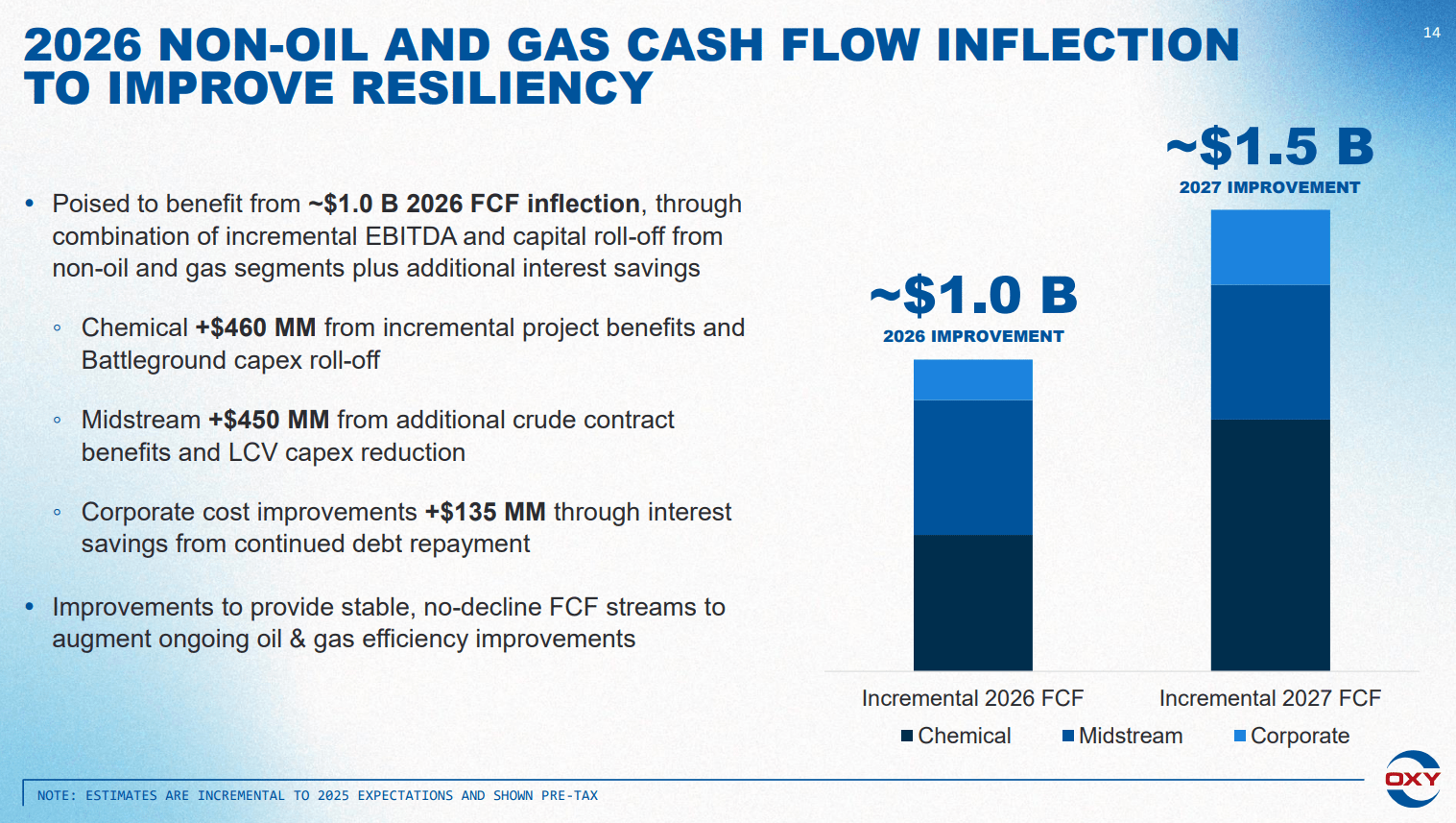
Source: Occidental Petroleum Q1 2025 Earnings Slide Presentation, May 8, 2025.
By 2027, I expect oil prices to be sustainably above $80 per barrel. By then, U.S. shale production is likely to be flat even at the higher prevailing prices. The global oil supply and demand balance will be vastly improved over 2026, when large inventory builds are expected to keep a lid on prices.
As for OXY’s cash flow sensitivity to commodity prices, the company offers investors the best of both worlds: a low breakeven price per barrel and significant cash flow torque to higher prices. Free cash flow breaks even at $51 per barrel WTI, assuming $3.00 per mcf natural gas prices. It is supported by OXY’s non-oil & gas-related cash flow. The chart below shows my estimate of free cash flow per share at different commodity prices.
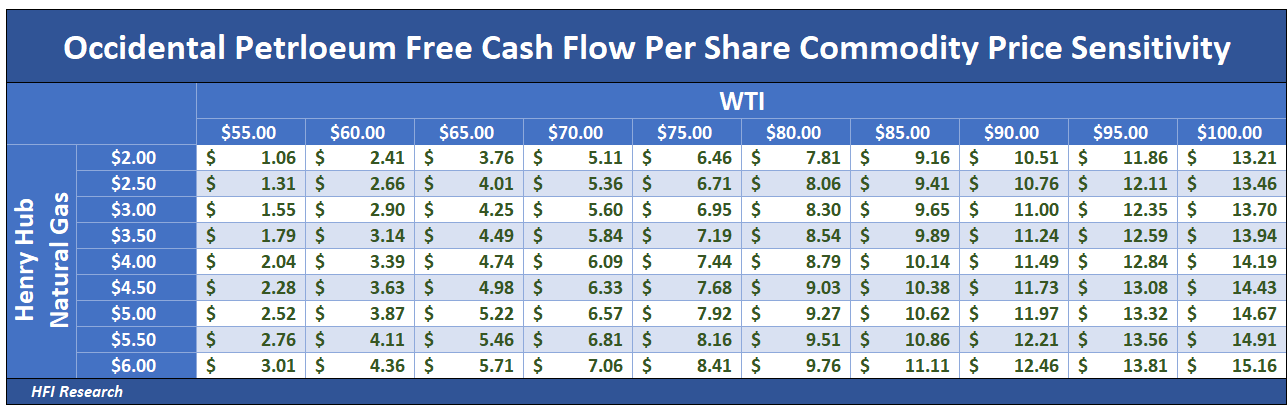
Assuming OXY shares sell at a 12% free cash flow yield, they offer the following returns at different commodity prices.
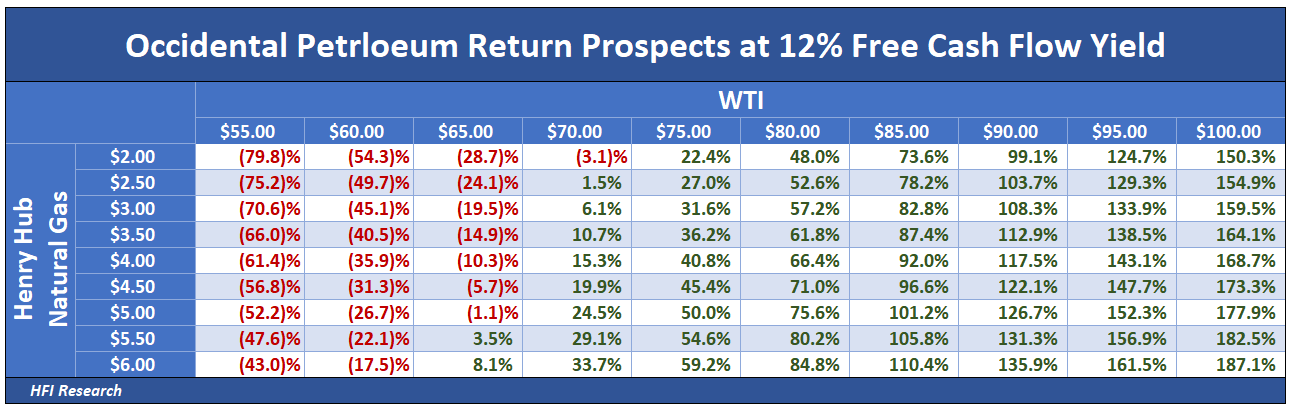
OXY shares currently discount WTI slightly below $70 per barrel at current natural gas prices. This is before taking into account the cash flow inflection its non-oil & gas-related operations are set to undergo in 2027. Natural gas prices could provide another tailwind for the shares if the thesis espoused by natural gas bulls plays out.
All in all, it’s an attractive long-term setup for an investor who expects WTI to average more than $70 per barrel over the next few years. You can count me in that group.
OXY Warrants
Investors looking to juice their returns should consider the OXY warrants. The warrants carry a $22.00 exercise price and expire on August 3, 2027. With the stock trading in the mid-$40s, they offer significant leverage to OXY’s stock price.
As always, investors should exercise caution when buying warrants, as losses suffered by the underlying stock are magnified, and the time available to recoup losses is limited by the expiration date. Despite these drawbacks, however, warrants for a large, relatively stable E&P like OXY can be a profitable way to play improving company fundamentals and a more bullish macro environment.
While 2025 and 2026 could shape up as a bust for oil bulls, 2027 looks far more constructive. In OXY’s case, it will see its cash flow increase materially in 2027, which is likely to be priced into OXY’s shares before the August 2027 expiration of its warrants. Debt reduction is another catalyst likely to add to the upside in the warrants by 2027.
The warrants are still a bit too rich for my tastes, given the fundamental macro oil market risks that lie on the horizon. However, if OXY shares were to fall below $40 within the next year, I would consider the warrants as a recovery trade into 2027.
Risks
Like all E&Ps, OXY’s cash flow is at risk from low oil prices. However, oil prices aren’t sustainable at a price around OXY’s cash flow breakeven. This can be viewed as a sort of margin of safety for OXY shareholders.
Deteriorating fundamental performance or a marked decrease in capital efficiency is another source of risk. These variables should therefore be monitored by long-term holders of the shares.
Another risk stems from an unexpected shutdown of the company’s international land holdings, though these are sufficiently diversified not to pose a high risk of significant permanent value destruction.
Arguably, the greatest risk to shareholders comes from a large, overpriced acquisition. Management barely survived the fallout of the Anadarko acquisition, so I doubt it would have the appetite to pursue an aggressive expansion. Moreover, OXY’s debt load is currently too high to attempt a large acquisition.
Overall, risks don’t loom particularly large in the picture for OXY, which is another positive aspect of the long-term investment thesis.
Conclusion
Whatever one’s stance on OXY, it’s hard to deny that its shares present an attractive package in the mid-$40s. Its shares have underperformed and are now discounting sustained low oil prices. I expect the company to continue to execute for shareholders. As it does, I expect its stock's recent underperformance to flip to outperformance. Investors who seek oil exposure over the short or long term should consider OXY shares as a top investment candidate.
Analyst’s Disclosure: I/we have no stock, option or similar derivative position in any of the companies mentioned, and no plans to initiate any such positions within the next 72 hours.