


By: Jon Costello
Greenfire Resources (GFR) (GFR:CA) is in the bull’s eye of what today’s market dislikes. It’s a microcap Canadian oil-sands producer that has been beset by management upheaval and operational mishaps since it came public in September 2023. The most recent headwind for GFR shares was the company’s dilutive rights offering, which increased the share count by 78% overnight on December 16.
Despite all the negatives, GFR’s prospects over the next few years are bright if oil prices increase as we expect. The fact is that energy investors today confront the difficult reality that E&P stocks are priced to reflect WTI in the low-US$70s per barrel, while the benchmark trades below US$60. Given the mispricing of so many of these stocks, investors who believe higher prices are imminent and that WTI will average more than US$70 per barrel over the long term may find GFR to be an attractive E&P alternative.
Background
GFR came public through a SPAC merger on September 21, 2023. The company was run by a team that appeared competent on paper but proved unable to meet its production objectives.
In September 2024, the Waterous Energy Fund (WEF) acquired a 43% stake in GFR’s common stock, primarily by acquiring blocks of shares from large shareholders. Waterous and the affiliates of the SPAC sponsor waged a proxy battle that ultimately ceded control to WEF, which emerged with a controlling 56.5% ownership interest in GFR’s common shares in late 2024.
WEF replaced GFR’s management team over the subsequent months, installing its own candidates, including Colin Germaniuk as President. Germaniuk is an engineer by training who possesses extensive experience in managing SAGD assets. His qualifications include being one of the earliest employees at Serafina Energy. Serafina owned and operated SAGD assets in Saskatchewan, growing production from zero to 40,000 boe/d over eight years. It was subsequently acquired by the WEF-controlled Strathcona Resources (SCR:CA) in August 2022 for $2.3 billion.
GFR currently trades at a market cap of $798 million based on its 125.4 million shares outstanding. In recent weeks, it completed a $300 million rights offering and redeemed its $237.5 million in 12% Senior Secured Notes due 2028. I assume it also used the offering to pay off the $50 million balance on GFR’s revolving credit facility. Combined with the $114.7 million in cash on the balance sheet at the end of the third quarter, the transactions have left the company with a large net cash balance and an enterprise value well below its market cap. The rights offering has de-risked the balance sheet, improved the company’s cash flow profile, and enhanced its operational flexibility.
After the rights issue, WEF owned 71.1% of GFR equity. Since WEF gained control of GFR, a major unresolved issue for GFR shareholders was what it planned to do with the company after having taken control. Was it going to fold GFR into Strathcona, or operate it as a standalone company and as a separate investment in one of its private equity funds?
Management’s comments suggest it plans to operate the business as a standalone entity and keep its public stock listing. I suspect it is doing so because GFR’s assets are not necessarily a proper fit within the larger Strathcona entity. Also, GFR presents relatively more upside given its smaller size, more focused operations, and greater torque to oil prices than Strathcona. The WEF also benefits from GFR’s public listing by providing a means to incentivize management and offering liquidity to the limited partners in its Waterous Energy Fund III fund, which holds GFR shares.
My previous GFR articles discuss GFR’s Expansion and Demo assets in the Hangingstone area of the Athabasca region in Alberta. The assets are located in the heart of oil sands country:

Source: Greenfire Resources Aug. 2024 Corporate Presentation.
While GFR’s Hangingstone assets aren’t of the highest quality among Canadian SAGD assets, they are among the highest quality of the SAGD assets not already owned by a larger operator.
Asset Value Exceeds Enterprise Value
One of the most attractive features of GFR shares is their current discount from net asset value.
The company’s 2024 reserve report lists 24.4 million barrels of net PDP reserves and 185.2 million barrels of net proved reserves. At its current production rate, PDP spans 4 years, and proved reserves span 32 years. At a higher production rate of 22,500 bbl/d, the PDP reserve life would fall to 3 years and proved reserves to 23 years.
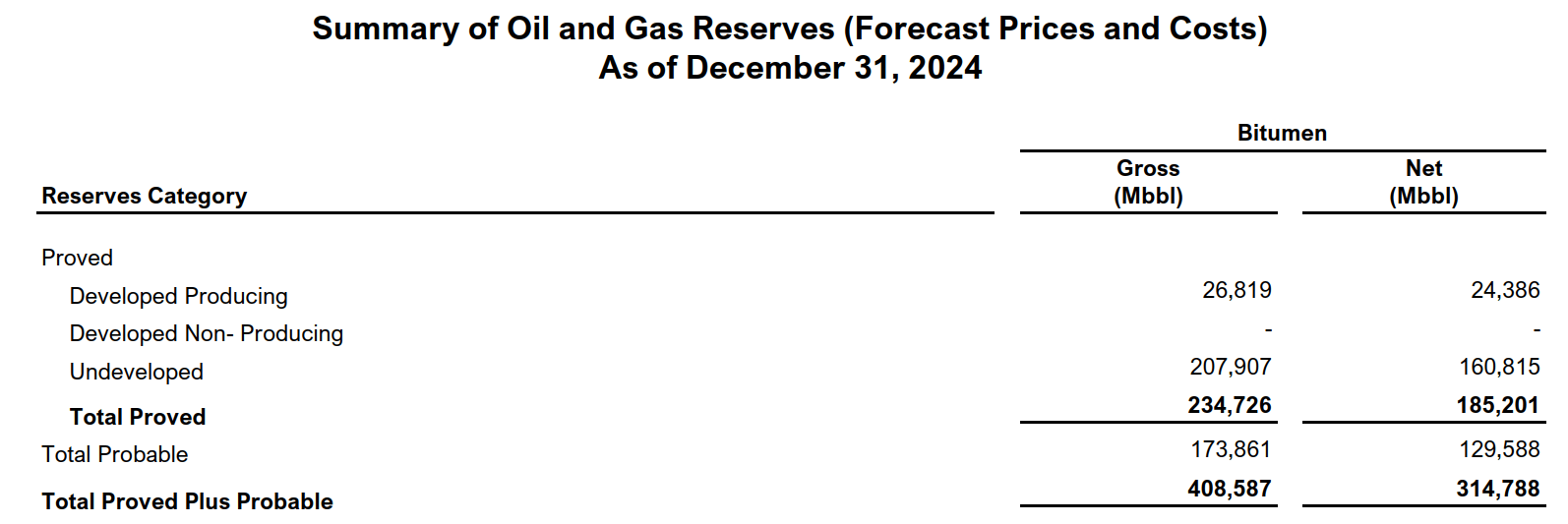
Source: Greenfire Resources 2024 Annual Information Form.
GFR’s reserve auditors estimate its PDP PV-10 value to be $693 million, slightly below the company’s current market cap of $798 million and its enterprise value of roughly $700 million. PDP per share is $5.53, versus today’s $6.36 share price.
Proved reserve PV-10 is estimated to be $2.05 billion, or $16.35 per share. However, these estimates assume that WTI trades in the mid-to-high US$70s per barrel over the next four years and increases into the US$80s and above thereafter. The values are significantly reduced at current oil prices.
Furthermore, the figures in the reserve report are based on prior management’s assumptions for development and operating costs. These will be potentially significantly different under the new management, so NPV estimates are likely to change.
According to my own modeling based on GFR’s 2024 reserve report, NAV per share declines to $7.58 at $65 per barrel WTI. GFR’s stock price is currently discounting WTI in the low-$60s per barrel. Oil prices will therefore have to increase from today’s US$57.50 and remain higher over at least the next few years for the stock to outperform. Investors should be well aware that with oil prices and GFR shares where they are today, higher oil prices, as well as management’s execution, will determine the success or failure of an investment in GFR equity over the long term.
GFR’s cash flow will be shielded from taxes and royalties for many years. Its $1.8 billion in tax pools will shield its income from taxes through the early to mid-2030s, while the low royalty rate to which the company will be subject as it recoups its capital investments will reduce the amount of royalties it pays relative to more mature assets over a similar timeframe.
Development Plan Aimed at Growth
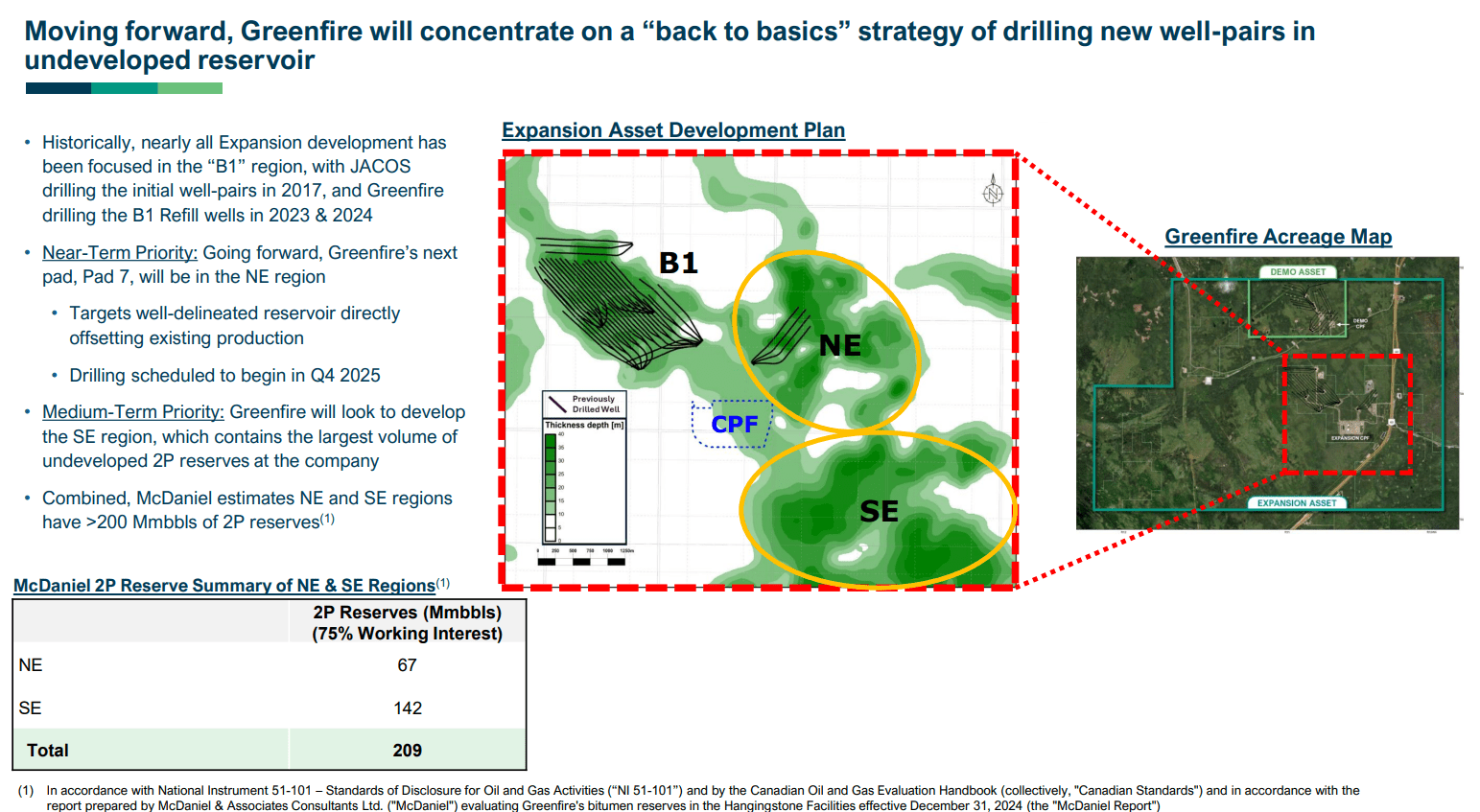
GFR’s new leadership plans to change tack from the previous management. Before Waterous’ involvement, the company was focused on boosting production by drilling lower-cost “refill wells,” which were essentially step-out wells located adjacent to previously drilled SAGD wells. GFR’s last SAGD well was drilled in 2013. The refill wells cost less than SAGD well pairs, but they entail the drawback of consuming PDP instead of creating value by converting proved reserves into PDP. The company was forced to drill refill wells due to the constraints imposed by its significant interest obligations and onerous debt covenants.
Source: Greenfire Resources, Q2 2025 Update, Sept. 2025.
GFR’s production is set to remain flat as it invests in its new SAGD wells. Management is guiding to 2026 bitumen production of roughly 15,500-to-16,500 bbl/d, essentially flat with the current level. At the same time, capital spending will step up materially. The board has approved a 2026 capital budget of approximately $180 million, up from $130 million in 2025. In 2026, it plans to spend $65 million on sustaining capex and $115 million in growth capex. Most of the growth spending will be directed toward its new Pad 7 and related infrastructure.
Pad 7 is scheduled to spud in late 2025 with first oil in late 2026. Production will then ramp during 2027. In the near term, GFR will focus on fixing its sulfur recovery unit and repairing its boilers. The efforts are aimed at preparing for growth in 2027 and beyond. This is the capital investment GFR needed that was apparently neglected by the previous management.
The heavy investment period makes for a cash flow profile that many public-market investors—both inside and outside the energy sector—tend to avoid. The strategy entails heavy upfront spending and significant operational risk. However, if GFR can successfully bring the 13 wells associated with Pad 7 onstream, it will have increased production to the mid-20,000 bbl/d range, with further growth to come. By then, the shares are likely to trade higher to reflect the value creation, as well as GFR’s growth prospects and free cash flow generation prospects at higher oil prices.
Valuation
Despite the recent dilution from the rights offering, GFR’s post-recapitalization economics remain attractive at the current stock price—as long as asset quality remains high and management can execute.
WEF acquired its equity stake in GFR at roughly $6.50 per share, which is equivalent to approximately $45,000 per flowing barrel. Sales of SAGD assets have typically occurred in the $60,000 range, whereas publicly traded SAGD E&Ps—which include Athabasca Oil (ATH:CA) and MEG Energy—have traded closer to $80,000 per flowing barrel. Assuming GFR’s management can boost the company’s production to near its 30,000 capacity, a rough metric of its value to an acquirer at $60,000 per flowing barrel would be around $1.8 billion, representing 138% upside from the current enterprise value.
In the third quarter, GFR produced 15,757 bbl/d at a realized price of US$64.93 per barrel WTI. Even at that low oil price, the company achieved an operating netback of $37.60 and free cash flow of $20.2 million, or $80.8 million on an annualized basis. With the elimination of $40 million of interest expense after the Senior Note redemption, a cash balance of more than $100 million, and most of its production over the next three quarters hedged at around current WTI prices, the company is likely to generate enough cash organically to fund its $180 million 2026 capex budget.
In 2027, I expect growth capex to remain elevated as the company focuses on its next SAGD pad. If WTI isn’t significantly higher by then, GFR could take on debt to fund additional capex. Doing so wouldn’t be a problem if the company exits 2026 in good financial condition, as I expect.
Longer term, normalized capex is likely to fall to the $110-to-$125 million range.
At US$75 per barrel WTI and production at 21,500 bbl/d, I estimate GFR can generate approximately $120 million in free cash flow, equivalent to a 20% free cash flow yield on the current enterprise value. With WEF in control, the company is likely to allocate that free cash flow intelligently for shareholders, whether through share repurchases, dividends, or other accretive measures.
Risks
The catch for current shareholders is that the GFR bull thesis depends on several factors that have yet to be proven beyond doubt. These include the company’s assets remaining high quality throughout their development over the coming quarters and management’s ability to successfully execute its development plan.
Furthermore, oil prices are likely to stay low for a few more quarters, and GFR shareholders will have to endure significant volatility in the share price as long as concerns of a massive oil glut depress investor sentiment. Moreover, given the weak oil price outlook, significant free cash flow is unlikely for GFR until its production heads above 20,000 bbl/d, likely in 2027. Consequently, I don’t expect any near-term catalysts to push the stock price higher.
The bull thesis also assumes that WEF will act in the interests of public shareholders to a similar extent as it acts in its own interests. This has also yet to be proven, and until it is, ownership of the shares entails some governance risk.
These risk factors favor a more cautious approach to accumulating shares over the next few months, or until the macro outlook for oil improves from its current dreadful state to marginally more positive.
Conclusion
Given the current slate of E&P opportunities available to public stock investors, GFR stands out as unusually attractive. Aside from the favorable factors mentioned above, it benefits from attractive capital efficiency below $20,000, its relatively fixed cost structure that embeds significant operating leverage, and excess infrastructure to accommodate 30,000 bbl/d of crude oil production.
However, these factors are moot until management can demonstrate operational excellence. Investors who buy now will need to monitor developments closely to ensure the company meets its objectives in a prudent manner. But if execution is strong, investors stand to benefit from years of outperformance. This prospect of high long-term returns makes the shares worth considering today.
Analyst’s Disclosure: I/we have a beneficial long position in the shares of GFR either through stock ownership, options, or other derivatives.