

By: Jon Costello
I got Hess Midstream (HESM) wrong. There is no way around it.
I bought HESM on April 29, 2021, at $23.42 and sold it on February 9, 2023, at $29.36, thinking it was fairly valued then. In August, I revisited the company and estimated its intrinsic value at $44 to $50 a share. I expected capital spending to decline sharply, allowing considerably more of the company’s earnings to become free cash flow. A possible buyout by Chevron (CVX) offered additional upside.
I recognized one risk. Chevron might eventually reduce the tariffs it paid HESM or direct production elsewhere. But I assumed that would become a serious concern after the existing contract terms ended in 2033. On October 6, Chevron announced an agreement that cuts its Bakken midstream costs beginning in 2027. I underestimated what Chevron could obtain from HESM while the contracts were still in place.
The shares closed at $32.26 on October 9, down 16.6% from their October 6 close of $38.69. That decline doesn’t convince me they are cheap. The transaction leaves public shareholders with lower earnings, more leverage, and little prospect of the distribution growth I expected. I would not buy the stock at that price, and if I owned it, I would consider selling.
What Chevron Gets
Chevron is giving up its interest in HESM, including control of the general partner, and contributing midstream assets in the DJ Basin. The assets include gathering and storage facilities and a 20% interest in the Saddlehorn pipeline. In return, HESM will cancel about 78.3 million Chevron-owned shares and equivalent units, reducing the number of economic interests outstanding by almost 40%. It will also pay Chevron $200 million, subject to a working-capital adjustment, principally using its credit facility. The transaction has not yet closed; the companies expect to complete it by year-end.
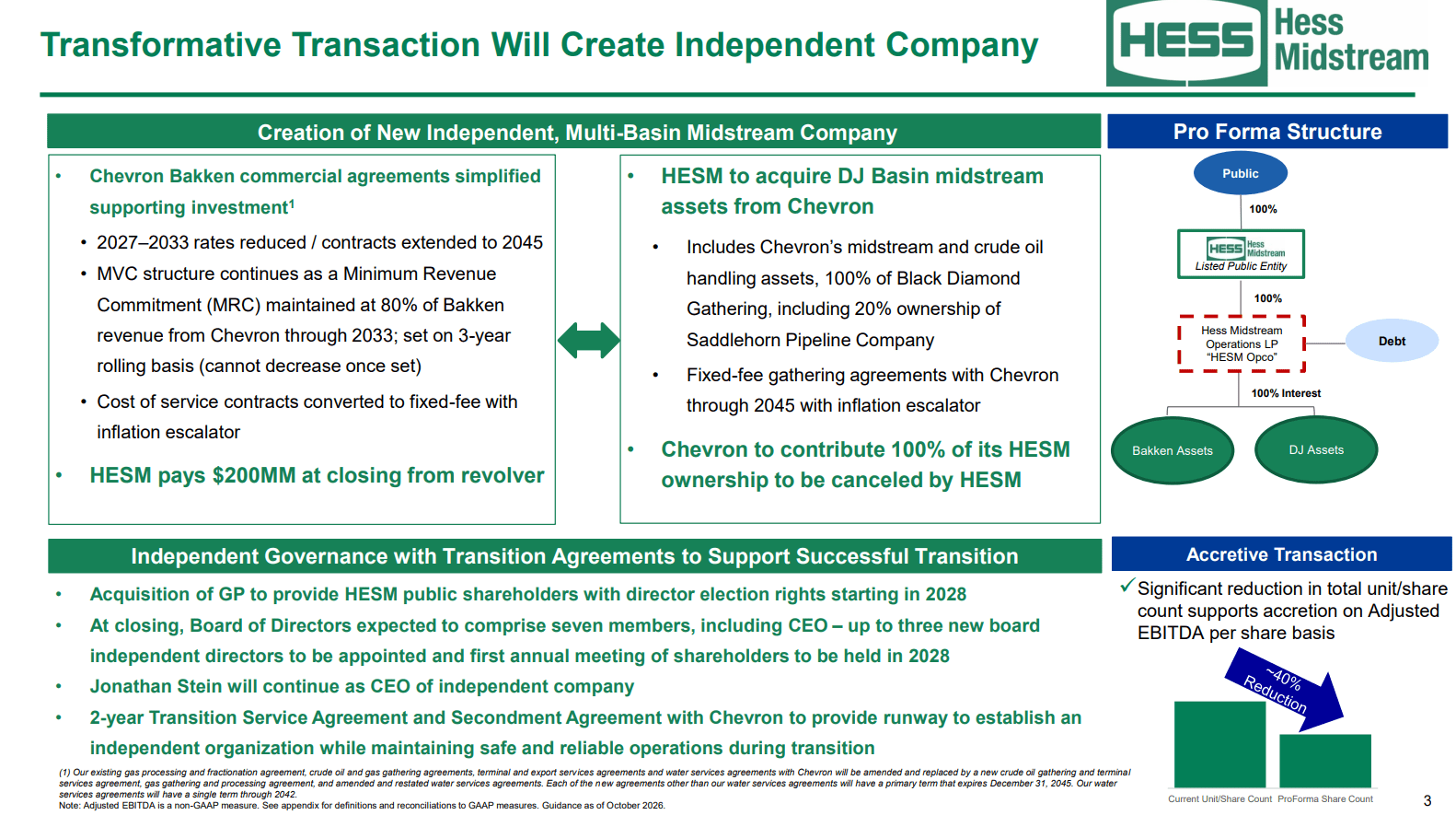
Source: Hess Midstream, Investor Update Call, October, 2026.
For Chevron, the most attractive part is the reduction in the fees it pays to move and process its Bakken production. Chevron estimates that its midstream cost per unit will fall by roughly 50%. It also plans to reduce its Bakken drilling program from three rigs to two. HESM receives another set of assets, a smaller share count, and longer commercial agreements, but gives up substantial revenue from its largest customer.
An independent conflicts committee approved the terms after receiving financial and legal advice. I have no basis for suggesting the agreement was improper. But Chevron was negotiating from a position of considerable strength, and the outcome seems much more favorable to Chevron than to the shareholders who will remain in HESM.